Cross-Chain BridgesTested10 OCT 26

Orbiter Finance Review
Maker-run bridge covering 74 chains, including Starknet, TON and Tron
Affiliate link · doesn't affect score · independent methodology
3.7/ 5Skrumble Score
In sintesi
Maker-run bridge whose docs list 74 mainnet chains, 13 of them non-EVM (Solana, Starknet, TON, Sui and Tron among them). A maker's wallet pays you out on the destination chain; SlowMist has audited its contracts and we found no protocol exploit.
Dettaglio punteggio Skrumble
3.7/ 5
Security & Audits (35% peso)3.2/5
Transaction Speed (20% peso)4.2/5
Fees (20% peso)3.5/5
Chains & Tokens Coverage (15% peso)4.9/5
Reliability (10% peso)3.3/5
Leggi la nostra metodologia di punteggio completa.
Statistiche rapide
- Supported chains
- 74+
- Typical fee
- Maker's % fee plus a fixed withholding fee
At A Glance
Who Is Orbiter Finance Best For?
Best for: Users who need wide chain coverage: Orbiter's docs list 74 mainnet chains, including Ethereum, Arbitrum and zkSync Era plus 13 non-EVM chains such as Starknet, TON and Tron. Skip if: You don't want to trust a maker's wallet with your funds, or you need a bridge whose value locked can be tracked.Our Take
Orbiter Finance offers the widest chain coverage we rank: its docs list 74 mainnet chains, 13 of them non-EVM (Solana, Starknet, TON, Sui and Tron among them). It is built for fast transfers, though we have not measured its speed, which depends on the maker. However, you send funds to a maker's wallet and trust the maker to pay you on the destination chain, and its value locked can't be tracked because the funds sit in those wallets. Test with a small amount before committing significant funds. On security, SlowMist has audited its bridge and maker contracts, and we found no protocol exploit. The incidents on record are a June 2023 takeover of its Discord server and failed transfers in October 2023 that the team blamed on users editing the transfer amount.Skrumble Scoring Breakdown
Our scoring reflects the widest network coverage we rank and a design built for speed, balanced against a security model that relies on trusting the maker and value locked that can't be tracked. See our full crypto bridge scoring methodology here.What is Orbiter Finance and How Does it Work?
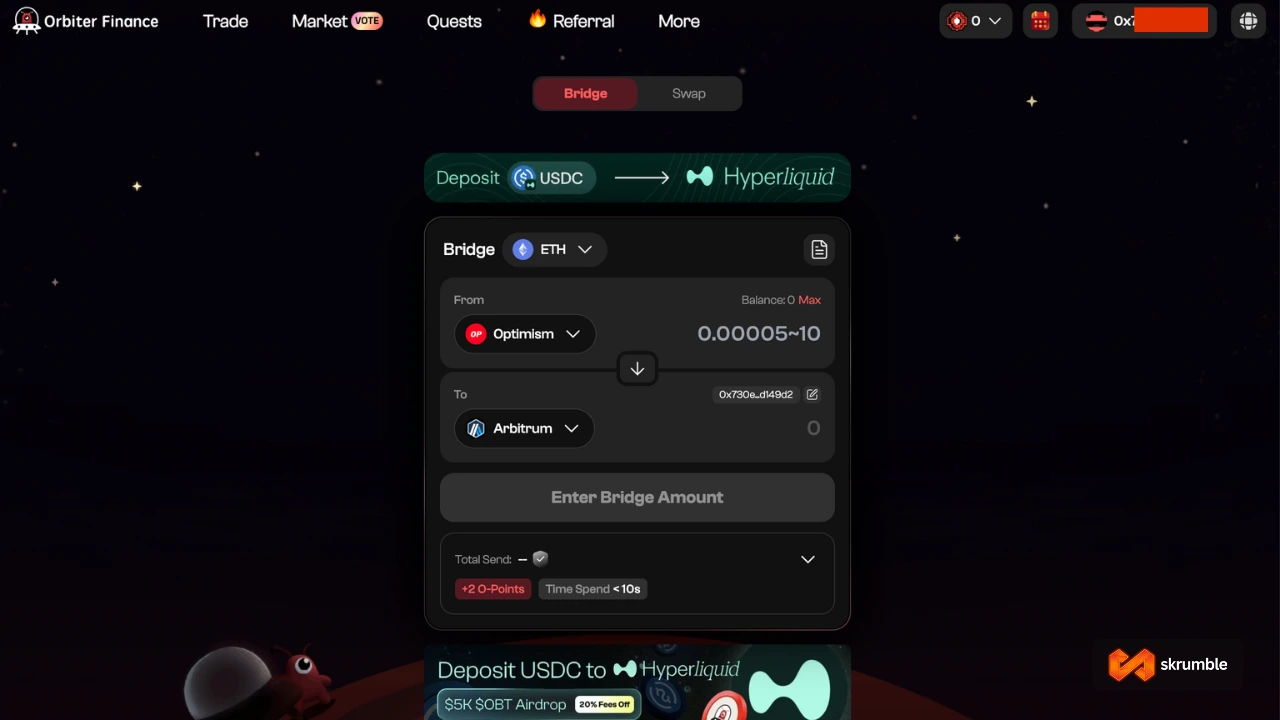 Orbiter Finance operates as a maker-run cross-chain bridge and swap app built for fast transfers of Ethereum native assets across Layer 2 networks, and it also reaches non-EVM chains such as Solana, Starknet, TON and Sui.
Unlike traditional bridge protocols, Orbiter Finance uses a maker-sender model where users initiate transactions directly to externally owned addresses (EOAs) rather than smart contracts, enabling faster processing times. The maker then pays you on the destination chain. The destination is encoded in the last four digits of the amount (the identification code), so never edit the amount by hand.
The protocol supports cross-rollup transactions between major networks including Ethereum, StarkNet, zkSync Era, Arbitrum, Optimism, Polygon, Base, and BNB Chain, among others.
Key Operational Features:
Orbiter Finance operates as a maker-run cross-chain bridge and swap app built for fast transfers of Ethereum native assets across Layer 2 networks, and it also reaches non-EVM chains such as Solana, Starknet, TON and Sui.
Unlike traditional bridge protocols, Orbiter Finance uses a maker-sender model where users initiate transactions directly to externally owned addresses (EOAs) rather than smart contracts, enabling faster processing times. The maker then pays you on the destination chain. The destination is encoded in the last four digits of the amount (the identification code), so never edit the amount by hand.
The protocol supports cross-rollup transactions between major networks including Ethereum, StarkNet, zkSync Era, Arbitrum, Optimism, Polygon, Base, and BNB Chain, among others.
Key Operational Features:
- Direct EOA transactions for faster processing
- Automated client systems for makers
- Three-parameter confirmation system (Token Standards, Amount, Destination Network)
- A documented smart contract arbitration path for disputes
Networks and Token Support
Supported Networks (74)
Orbiter's docs list 74 mainnet chains: 61 EVM networks, including Ethereum and its Layer 2s, and 13 non-EVM chains (Solana, Sonic SVM, Eclipse, Starknet, Paradex, TON, Sui, Tron, Fuel, Movement, Immutable X, zkSync Lite and HyperCore).Supported Tokens
- Orbiter's fee examples use ETH and USDC, a stablecoin, but we could not verify a current list of supported tokens.
- Orbiter now offers bridging and swaps, so check in the app that your token is available on your route before you send.
Orbiter Finance Fees
Fee Structure
- Trading Fees: a percentage of the transfer amount
- Withholding Fee: One-time fee covering destination network gas costs
- Variable Rates: Makers set their own fee percentages
Fee Examples
Orbiter's docs give two undated examples for transfers from Ethereum mainnet to zkSync: 1 ETH costs 0.03% plus a 0.0014 ETH withholding fee, and 100 USDC costs 0.3% plus 1.5 USDC, or 1.8 USDC in total. Because the withholding fee is fixed, it weighs more on small transfers. We could not get a live quote from Orbiter, so check the total in the app before you confirm; exact costs vary by network congestion and maker settings.Security and Safety
Security Architecture
Orbiter's docs describe an optimistic design: if a maker fails to pay, you can go to arbitration and claim a refund plus the maker's margin. The docs don't say whether arbitration is live on every route, so in practice you are trusting the maker to pay. The design uses:- Arbitration mechanism for dispute resolution
- Three-part validation system: the MDC deposit contract, the EBC event-binding contract and ZK-SPV proofs
- Zero-Knowledge proof technology for transaction verification
Audit Status
SlowMist has audited Orbiter three times, covering the official bridge, the decentralized maker contracts and the Swap/Bridge/OPool contracts. The reports are listed, undated, in Orbiter's documentation.Incident History
We found no protocol-level exploit of Orbiter Finance, and DefiLlama's hacks database lists none. The incidents on record are:- June 2023: attackers took over Orbiter's Discord server and posted a fake airdrop.
- October 2023: some transfers failed and rug-pull accusations spread after Orbiter's Discord account went offline. The team said Discord had blocked the account, denied any security issue and said the failed transfers came from users editing the identification code in the amount.
- Not Orbiter: the January 2024 hack of Orbit Bridge hit a different, unrelated project.
Staking and Liquidity Provision
Currently, liquidity provision is primarily managed by the Orbiter Finance team rather than offering public participation. Orbiter has built a decentralized maker system, and SlowMist has audited its decentralized maker contracts, but we could not confirm whether outside makers can join today. In Orbiter's current fee model, each maker can:- Set their own trading fees
Orbiter Finance Native Token
Orbiter Finance launched its OBT native token on 20 January 2025 (token generation event); earlier versions of the platform had no token. OBT has a total supply of 10 billion and launched on Ethereum, Arbitrum and Base.Things We Don't Like About Orbiter Finance
Major limitations we have found:- You trust the maker to pay, and the docs don't say whether arbitration is live on every route
- Value locked can't be tracked, because funds sit in maker wallets
- Limited public liquidity provision reduces decentralization
- Maker system complexity may intimidate new users
- Fewer integrations: the LI.FI aggregator no longer lists Orbiter among its 36 bridges (October 2026)
Conclusion
Orbiter Finance stands out for network coverage: its docs list 74 mainnet chains, including Starknet, TON, Tron and other non-EVM chains, the widest coverage of any bridge we rank. It is built for fast transfers, though we have not measured its speed. However, you trust a maker to pay you on the destination chain, its value locked can't be tracked, and its fixed withholding fee weighs more on small transfers. SlowMist has audited its contracts, and we found no protocol exploit. The platform works best for users who need a chain the others don't reach and who start with a small test transfer.Skrumble Community Ratings
We're building our Orbiter Finance review section! Share your experience to help others, particularly regarding:- Your experience with transaction speeds across different networks
- How fees compare to other bridges for similar transfers
- Any issues with failed or delayed transactions
- Support quality and response times for technical problems
- NFT reward system experience and benefits
FAQs
Is Orbiter Finance Legitimate?
+ Yes. Orbiter Finance is an active bridge and swap app, SlowMist has audited its contracts, and we found no protocol-level exploit. Its 2023 incidents were a Discord takeover with a fake airdrop and failed transfers that the team attributed to users editing the amount.How Much Does Orbiter Finance Cost?
+ You pay a percentage trading fee set by the maker plus a fixed withholding fee that covers gas on the destination chain. In Orbiter's undated docs examples from Ethereum mainnet to zkSync, 1 ETH costs 0.03% plus 0.0014 ETH, and 100 USDC costs 0.3% plus 1.5 USDC (1.8 USDC in total). Check the total in the app before you confirm.Is Orbiter Finance Safe to Use?
+ SlowMist has audited Orbiter's bridge and maker contracts, and we found no protocol exploit. The main risk is the design: you send funds to a maker's wallet and trust the maker to pay you on the destination chain. Orbiter documents an arbitration path for failed transfers but doesn't say whether it is live on every route, so test with a small amount first and never edit the amount by hand.What Networks Does Orbiter Finance Support?
+ Orbiter's docs list 74 mainnet chains: 61 EVM networks and 13 non-EVM chains, including Solana, Starknet, TON, Sui, Tron, Fuel and HyperCore.What Tokens Can I Bridge on Orbiter Finance?
+ Orbiter's fee examples use ETH and USDC, but we could not verify a current token list. Check in the app that your token is available on your route before you send.Risk Warning:
Trading Forex, CFDs, and cryptocurrencies carries a high level of risk and may not be suitable for all investors. These markets are volatile and can result in the loss of your invested capital. Make sure you fully understand the risks before trading.Screenshots captured during testing