

Binance Bridge Review
Custodial Binance bridge, no longer offered as a standalone product
Status, checked 10 October 2026: Binance Bridge is no longer offered as a standalone product: its page on binance.com returns a 404 and BNB Chain's bridge page no longer lists it. BEP-2 tokens were retired with BNB Beacon Chain on 19 November 2024. We no longer recommend it and keep this review for reference. To move funds onto BNB Chain, withdraw from Binance directly to BNB Smart Chain or use the opBNB bridge. See the crypto bridges we recommend instead.
Resumo
Binance Bridge 2.0, launched in March 2022, was a custodial bridge: transfers ran through a Binance account and the bridge issued BTokens pegged 1:1. It is no longer offered as a standalone product, so we do not score or recommend it.
Background reading only. Binance Bridge is no longer offered, so we do not recommend it for any transfer.
You need to move funds today. Withdraw from Binance directly to BNB Smart Chain, or use the opBNB bridge.
At A Glance
Who Is Binance Bridge Best For?
Best for: No one today. Binance Bridge is no longer offered as a standalone product, so we keep this review as a record of how it worked and what to use instead. If your funds are on Binance, withdraw them directly to BNB Smart Chain. Skip if: You need a working bridge. Withdraw from Binance directly to BNB Smart Chain or use the opBNB bridge instead.Our Take
Binance Bridge is no longer offered as a standalone product. Its page on binance.com returns a 404, and BNB Chain's bridge page lists the BNB Greenfield and opBNB bridges but no Binance Bridge. We found no official discontinuation notice, so we describe it as no longer offered rather than officially closed. When it ran, Binance Bridge 2.0 was a custodial bridge: transfers went through your Binance account, so you trusted the exchange with the assets you moved. We no longer recommend it, and it has no Skrumble score.Why Binance Bridge Has No Score
We do not score Binance Bridge because it is no longer offered. See our full crypto bridge scoring methodology here.What Was Binance Bridge and How Did it Work?
Binance Bridge came in two versions. The original Binance Bridge, launched in 2020, used a peg-in and peg-out model and closed on 25 November 2021. Binance Bridge 2.0 launched in March 2022 as a custodial bridge: transfers ran through a Binance account, and the bridge issued BTokens pegged 1:1. Neither version is available today. The bridge page on binance.com returns a 404, and BNB Chain's bridge page no longer lists a Binance Bridge.Key Mechanisms
Binance Bridge 2.0 relied on Binance as custodian, so users trusted the exchange to hold the assets behind each BToken. It was a different system from the BSC Token Hub, the bridge between BNB Beacon Chain and BNB Smart Chain, which used relayers and light-client proof checks on BSC. The Token Hub, not Binance Bridge 2.0, was the component exploited in October 2022.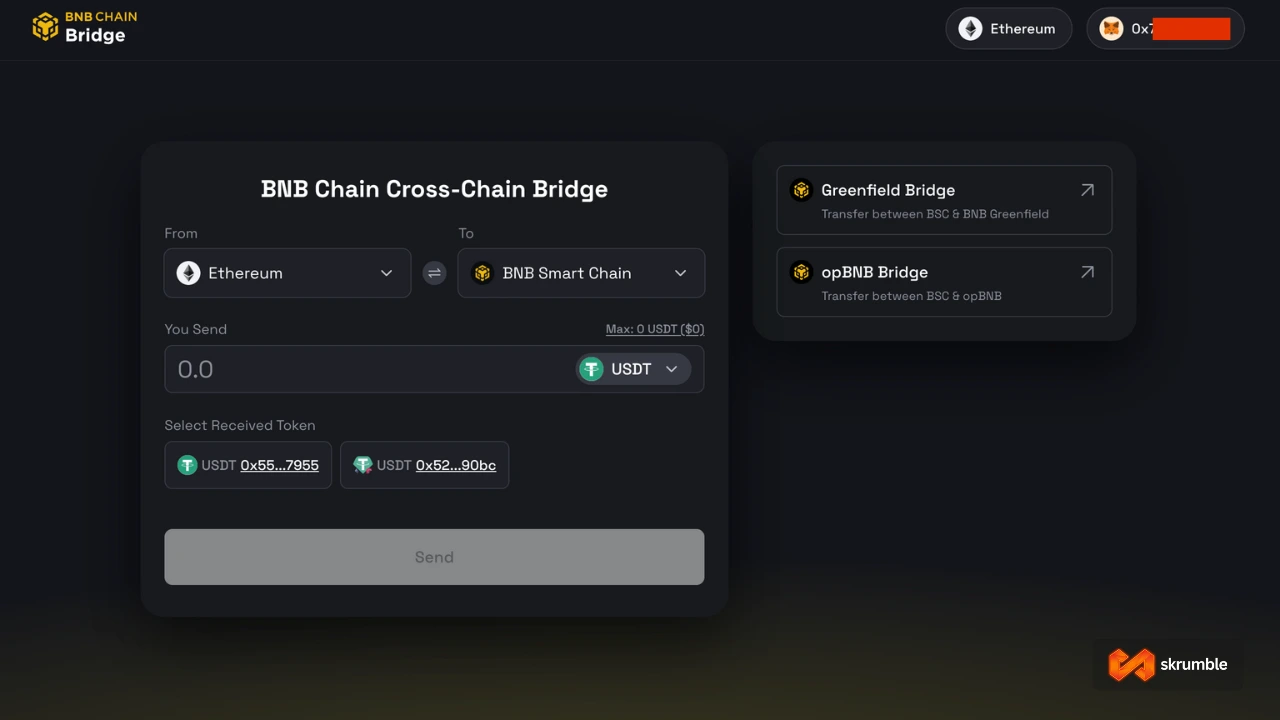
Supported Networks and Tokens
Binance Bridge supports no networks or tokens today because it is no longer offered. BEP-2 tokens were retired with BNB Beacon Chain on 19 November 2024, when transfers between BNB Beacon Chain and BNB Smart Chain also stopped.Fees and Transaction Costs
We no longer list a fee for Binance Bridge because the product is no longer offered. If you move funds by withdrawing from Binance directly to BNB Smart Chain, check the fee shown before you confirm.Security Analysis
Binance Bridge 2.0 was custodial, so its security depended on Binance, which held the assets behind each BToken.Historical Security Events
On 6 October 2022 an attacker exploited the BSC Token Hub, the bridge between BNB Beacon Chain and BNB Smart Chain, not Binance Bridge 2.0. A forged proof let the attacker mint 2 million BNB (about $570 million). Between $100 million and $137 million moved off BNB Smart Chain before validators halted the chain, and about $7 million was frozen. The rest of the minted BNB never left BSC.Current Security Status
There is no live Binance Bridge to secure today. Transfers through the BSC Token Hub ended when BNB Beacon Chain shut down on 19 November 2024, which halted cross-chain transfers between Beacon Chain and BNB Smart Chain.Alternatives and Competitors
To move funds onto BNB Chain today, withdraw from Binance directly to BNB Smart Chain or use the opBNB bridge listed on BNB Chain's bridge page. For other routes, Across Protocol supports BNB Smart Chain, Stargate Finance, whose pool chains include BNB Chain, moves native USDC, USDT and ETH between major EVM chains, and Portal Bridge covers Solana and other non-EVM chains. We rank these and other bridges on fees, speed and hack history in our guide to the best crypto bridges.Reality Check: Limitations to Consider
The biggest limitation is that Binance Bridge is no longer offered, so there is no route left to use. When it ran, the custodial design meant users had to trust Binance with the assets they moved. The October 2022 exploit hit the BSC Token Hub rather than Binance Bridge 2.0, and it was not a case of quick recovery: between $100 million and $137 million left BNB Smart Chain before validators halted it, and about $7 million was frozen.Things We Do Not Like About Binance Bridge
The main problem is availability. The product page returns a 404, BNB Chain no longer lists the bridge, and we found no official notice from Binance explaining its status. The custodial design was the other drawback while it ran, because Binance held the assets behind every BToken and users depended on a single company.Conclusion
Binance Bridge is no longer offered as a standalone product, so we no longer recommend it and do not give it a score. BEP-2 tokens were retired with BNB Beacon Chain on 19 November 2024, and the bridge's page on binance.com returns a 404. To move funds onto BNB Chain, withdraw from Binance directly to BNB Smart Chain or use the opBNB bridge. For other routes, use one of the bridges listed under Alternatives above.FAQs
Is Binance Bridge Safe?
+ There is nothing to use today. When it ran, Bridge 2.0 was custodial, so its safety depended on Binance. The October 2022 exploit, in which an attacker minted 2 million BNB, hit the BSC Token Hub rather than Binance Bridge 2.0.How Long Do Binance Bridge Transfers Take?
+ Binance Bridge no longer processes transfers. The closest replacement is withdrawing from Binance directly to BNB Smart Chain.Can US Users Access Binance Bridge?
+ No, and neither can anyone else, because its page on binance.com returns a 404 and BNB Chain no longer lists it.What Networks Does Binance Bridge Support?
+ None today. BEP-2 tokens were retired with BNB Beacon Chain on 19 November 2024. For multi-chain transfers, consider Portal Bridge for Solana and other non-EVM chains, or Stargate Finance for native USDC, USDT and ETH between major EVM chains.How Do Binance Bridge Fees Compare to Alternatives?
+ There is no current fee to compare. For bridges you can use today, see the Alternatives section above.Risk Warning:
Trading Forex, CFDs, and cryptocurrencies carries a high level of risk and may not be suitable for all investors. These markets are volatile and can result in the loss of your invested capital. Make sure you fully understand the risks before trading.Screenshots