What is a Zero Knowledge Proof? 2026 zk-SNARK + STARK Guide
What is a zero knowledge proof in 2026: cryptographic prove-without-revealing primitive, zk-SNARK vs zk-STARK trade-offs, ZK rollup scaling, ZK identity systems.
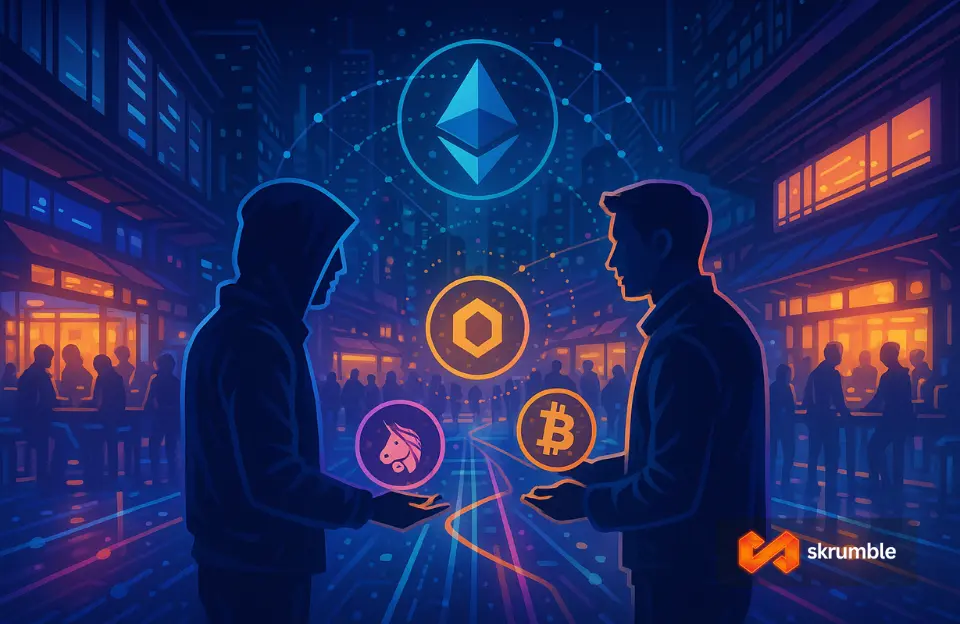
What is a zero knowledge proof? A zero knowledge proof (ZKP) is a cryptographic technique that lets one party (the prover) convince another party (the verifier) that a statement is true without revealing any information beyond the truth of the statement itself. The prover demonstrates "I know x" without revealing x. In 2026, ZKPs have moved from research curiosity to production infrastructure underpinning major Ethereum scaling solutions, privacy-preserving identity systems, and emerging compliance applications. The total market capitalization of ZK-focused crypto projects exceeds $11.7 billion with approximately $3.5 billion in 24-hour trading volume. The two dominant families: zk-SNARKs (Succinct Non-interactive ARguments of Knowledge), which produce very small proofs (hundreds of bytes) with constant-time verification but historically required trusted setup ceremonies; zk-STARKs (Scalable Transparent ARguments of Knowledge), which remove the trusted-setup requirement and provide post-quantum security at the cost of larger proof sizes. ZK rollups (zkSync Era, Scroll, Linea, Polygon zkEVM, Starknet) use validity proofs to settle thousands of transactions per batch onto Ethereum at a fraction of mainnet gas. Privacy-preserving identity systems like Worldcoin's Proof of Personhood and Polygon ID let users prove KYC verification or human-ness without revealing biometric data.
This guide on what is a zero knowledge proof walks the cryptographic mechanics with concrete examples, the zk-SNARK vs zk-STARK trade-off, the production use cases (rollups, identity, privacy protocols), the leading 2026 ZK projects, the honest limitations, and how ZKPs differ from related cryptographic primitives. For broader L2 scaling context, see our rollup pillar guide; for the smart-contract substrate, see what is a smart contract.
What is a zero knowledge proof in simple terms?
The classic illustration uses a colorblind verifier. The prover has two balls (one red, one green); the verifier is colorblind and cannot tell them apart. The prover wants to convince the verifier that the balls are different colors without revealing which is which. The protocol: the verifier holds one ball in each hand, then secretly swaps them behind their back (or not), then shows them to the prover. The prover correctly states whether a swap occurred. Repeated many times, the probability of guessing correctly without genuinely seeing different colors becomes vanishingly small. The verifier becomes convinced the balls are differently colored without ever learning which is red and which is green.
Modern cryptographic zero knowledge proofs achieve this same property for arbitrary statements expressible in mathematical form. A ZKP for "I know the password to this account" lets you prove the knowledge without revealing the password. A ZKP for "I am over 18 and a citizen of country X" lets you prove eligibility without revealing date of birth or specific identity. The applications scale to arbitrary computation: "I executed this program correctly on this input" can be proven without re-executing the program, which is the structural insight behind ZK rollups.
What is the difference between zk-SNARK and zk-STARK?
Both are zero-knowledge proof systems with different engineering trade-offs.
zk-SNARK (Succinct Non-interactive ARgument of Knowledge): produces very small proofs, typically a few hundred bytes. Verification is constant-time and inexpensive. The historical drawback is the trusted-setup requirement: generating the proof system parameters requires a one-time ceremony where the participants must securely destroy their randomness (the "toxic waste"). If any single participant retains the randomness, they can forge proofs. Modern SNARK constructions (Groth16, PLONK, Halo2) have substantially reduced or eliminated the trusted-setup requirement; PLONK uses a universal trusted setup that needs to run only once and can be reused for any circuit.
zk-STARK (Scalable Transparent ARgument of Knowledge): produces larger proofs (typically 100-300 kilobytes) but requires no trusted setup. The "transparent" property means the proof system is fully auditable and relies only on cryptographic hash functions (specifically collision-resistant hashes), which makes STARKs post-quantum-secure: even a future quantum computer cannot break STARK soundness. STARKs are the basis of StarkNet's validity-proof system. The trade-off: STARKs are heavier to generate and verify than SNARKs, though continued research has narrowed the performance gap.
The 2026 production landscape: SNARK-derived systems (Groth16, PLONK, Halo2) dominate ZK rollups due to their proof-size advantage; STARKs dominate use cases that prioritize transparency and quantum resistance (StarkNet, certain enterprise applications). Both are production-ready; the choice depends on application requirements. The Ethereum Foundation maintains a canonical ZK overview at ethereum.org/zero-knowledge-proofs.
How are ZKPs used in crypto?
Five major use-case categories define the 2026 ZK landscape.
- ZK rollups: the largest production use. zkSync Era, Scroll, Linea, Polygon zkEVM, and Starknet use validity proofs to settle thousands of L2 transactions in a single proof posted to Ethereum mainnet. The validity proof guarantees the rollup's state transitions are correct; mainnet verifies the proof and finalizes the batch immediately, without the 7-day challenge window optimistic rollups require. For rollup-architecture detail, see our rollup pillar guide.
- Privacy-preserving transactions: Aztec Network V2, Zcash, and Privacy Pools use ZKPs to enable confidential transfers where amounts, senders, or recipients can be hidden while the network still verifies validity. Aztec's design allows fully private DeFi (private balances, private swaps, private LP positions).
- Identity and proof of personhood: Worldcoin's Proof of Personhood uses ZKPs to verify uniqueness without revealing iris-scan biometrics; Polygon ID enables selective KYC disclosure (prove you are over 18 without revealing date of birth). The category is expanding rapidly through 2025-2026 with regulated-compliance applications.
- Cross-chain bridges and interoperability: Succinct Labs, Polyhedra Network, and zkBridge architectures use ZK proofs to verify state from one chain on another chain without requiring trusted committees of validators. This is structurally safer than typical bridge designs.
- Computation off-chain with on-chain verification: the most general use case. Any expensive computation can be done off-chain with a ZK proof posted on-chain. Applications: machine-learning inference verification, game-state verification, exchange-reserve attestation, regulated-compliance reporting.
How does a ZK rollup work?
A ZK rollup operates as a separate execution environment that submits batches to Ethereum mainnet along with a cryptographic proof that the batch was processed correctly. The architecture: users send transactions to the rollup's sequencer; the sequencer batches transactions and executes them against the rollup state; a prover (off-chain professional service) generates a ZK proof that the batch's state transitions are valid; the rollup contract on Ethereum verifies the proof; the batch is finalized.
The user experience: transactions on a ZK rollup feel like transactions on Ethereum mainnet but cost a fraction of the gas (typical 2026 fees $0.001-$0.05). Withdrawal back to mainnet is hours rather than days because the validity proof finalizes the batch immediately, with no challenge window required. The trade-off historically was EVM compatibility (custom languages like Cairo for StarkNet) and proof-generation cost; both have materially improved through 2024-2026. zkEVM systems (zkSync Era, Scroll, Linea, Polygon zkEVM) now offer near-perfect Ethereum-compatibility while preserving validity-proof finality.
What is Worldcoin Proof of Personhood?
Worldcoin uses ZKPs for the Proof of Personhood (PoP) protocol: a unique-human verification that does not reveal iris-scan biometric data. The flow: a user has their iris scanned by a Worldcoin Orb (specialized hardware); the Orb computes a hash of the iris signature and stores only the hash; the user receives a World ID linked to that hash; when proving humanness in an application, the user generates a ZK proof that they hold a valid World ID without revealing which World ID it is.
The application: humanness verification for Sybil-resistant airdrops, voting in DAOs (one human one vote rather than one token one vote), AI-content distinction (proving a piece of content was generated by a verified human rather than a bot), and similar use cases. The 2025 US enforcement clarity allowed Worldcoin to resume US operations; the network has onboarded millions of verified users worldwide. The honest criticisms: biometric collection raises privacy and surveillance concerns even with cryptographic protection; the Orb-distribution model is uneven across geographies; the underlying business model is still evolving.
What is Polygon ID and how does it use ZKPs?
Polygon ID is a decentralized identity (DID) framework that uses ZKPs to enable selective disclosure of identity attributes. The flow: a trusted issuer (a government, a university, a KYC provider) issues a cryptographic credential to a user attesting to some attribute (age, citizenship, KYC-verified status). The user stores the credential in their wallet. When an application requests proof of an attribute ("prove you are over 21"), the user generates a ZK proof of that specific claim without revealing the underlying credential details.
The result: regulated DeFi protocols can require KYC for access without seeing the user's full identity; age-gated services can require proof of age without storing birthdates; sanctions-screening can verify the user is not on a sanctions list without revealing their identity. The 2026 production use cases: regulated DeFi access (Aave Arc, Compound Treasury), age verification for adult-content platforms, regulated stablecoin minting flows. Similar frameworks include zkPass, Sismo, Disco, and several enterprise-focused alternatives.
What are the limitations of ZKPs?
Five honest limitations. Proof-generation cost: generating a ZK proof is computationally expensive. A single zk-SNARK proof for a complex computation can take seconds to minutes to generate on consumer hardware; enterprise applications use specialized hardware (GPUs, FPGAs, custom ASICs). The proving cost is the dominant operational expense for ZK rollups. Trust-setup ceremonies: SNARK constructions that require trusted setup carry the residual risk that the ceremony participants colluded. Modern universal setups (PLONK's KZG ceremony) materially reduce but do not entirely eliminate this concern. STARKs avoid the issue entirely.
Quantum security: classical zk-SNARKs (Groth16) are not post-quantum secure; a sufficiently powerful quantum computer could forge proofs. STARKs and certain SNARK variants (Halo2, lattice-based constructions) are quantum-secure. Implementation complexity: the math is sophisticated; small bugs in ZK circuit implementations have led to security incidents (the 2024 Polygon zkEVM vulnerability requiring an emergency patch is a representative case). Limited general programmability: writing ZK circuits requires specialized languages (Circom, Cairo, Noir, Halo2 DSL); the developer ecosystem is smaller than Solidity-on-EVM. The 2026 trend toward zkEVMs and general-purpose ZK virtual machines is addressing this gap.
What are the leading ZK projects in 2026?
The 2026 ZK landscape splits into four categories.
- ZK rollups (scaling): zkSync Era, Scroll, Linea, Polygon zkEVM, Starknet. Combined L2 TVL across ZK rollups in the multi-billion-dollar range.
- Privacy protocols: Aztec Network (privacy-focused L2), Zcash (privacy-coin pioneer), Privacy Pools (compliance-aware privacy mixers), Penumbra (private DEX).
- Identity and proof of personhood: Worldcoin (biometric PoP), Polygon ID (selective disclosure), zkPass, Sismo, Disco.
- Infrastructure and prover networks: Succinct Labs (zkBridge and general proving), RISC Zero (zkVM enabling proving of arbitrary programs), Polyhedra Network, Aligned Layer (proof aggregation).
Combined ZK-project market cap exceeds $11.7 billion with $3.5 billion in 24-hour trading volume. The space is maturing rapidly; production deployment has materially expanded through 2024-2026 across all four categories.
Frequently asked questions
Are zero knowledge proofs only used in crypto?
No. ZKPs are general cryptographic primitives with applications far beyond crypto. Enterprise use cases include privacy-preserving database queries, financial-services compliance attestation (proving solvency without revealing positions), authenticated medical-record sharing, and verifiable machine-learning inference. Crypto has been the leading deployment domain because the financial incentives for proof-of-correct-computation are clearest, but the underlying technology applies broadly.
Are zero knowledge proofs the same as homomorphic encryption?
No, though both are advanced cryptographic primitives. ZKPs let you prove a statement about hidden data without revealing the data. Homomorphic encryption lets you perform computations on encrypted data and get encrypted results that, when decrypted, match the result of the same computation on the unencrypted inputs. They can be complementary in some advanced applications, but they solve different problems.
Can quantum computers break zero knowledge proofs?
It depends on the specific construction. Classical zk-SNARKs based on elliptic-curve cryptography (Groth16) are vulnerable to sufficiently powerful quantum computers. zk-STARKs and post-quantum SNARK variants (Halo2, lattice-based constructions) are designed to be quantum-resistant. The 2026 trend among new ZK deployments is toward post-quantum constructions as a defensive default.
How is a zero knowledge proof different from a digital signature?
A digital signature proves "I, the holder of private key K, authorize this message." A zero knowledge proof can prove much more general statements: "I know the private key corresponding to this public key without revealing which key it is," "I executed this complex computation correctly on inputs I am not revealing," "this batch of 1,000 transactions is correctly processed." Signatures are a specific kind of authentication; ZKPs are a general framework for proving arbitrary statements without revealing inputs.
What is a trusted setup ceremony?
A one-time event where multiple participants jointly generate the public parameters needed for a zk-SNARK system. Each participant contributes their own randomness; the protocol combines all contributions; participants must securely destroy their individual randomness ("toxic waste") afterward. If even one participant honestly destroys their share, the system remains secure. The 2018 Zcash Powers of Tau ceremony (with hundreds of independent participants), the 2023 KZG ceremony for Ethereum proto-danksharding (with 140,000+ participants), and similar large-scale ceremonies provide cryptographic confidence that no one entity could compromise the setup.
Can I use zero knowledge proofs in my own application?
Yes, increasingly. ZK developer tooling has matured: Circom for circuit design, Noir as a Rust-like high-level ZK language, RISC Zero's zkVM that compiles standard programs to ZK proofs, and Aleo's Leo language for privacy-preserving applications. Building production ZK applications still requires specialized expertise but is materially more accessible than it was 2-3 years ago. Cloud-based proving services (Succinct, Risc0 Bonsai) lower the infrastructure barrier further.
Are ZK projects a good investment?
This is not financial advice. The ZK category has performed strongly in cumulative terms (combined market cap $11.7+ billion in 2026); within the category, individual project performance varies materially. The technology is structurally important to Ethereum's roadmap and to crypto's broader privacy and identity infrastructure. Whether any specific ZK project is a good investment depends on the project's adoption, tokenomics, team, and competitive position, not on the technology category alone.
Will ZK proofs make all crypto private?
No, not by default. Privacy in crypto requires both privacy-preserving infrastructure (which ZKPs enable) and user-level adoption (which requires opt-in privacy use). The current trajectory: privacy-preserving L2s and protocols are growing but still represent a minority of total on-chain activity. Regulatory pressure on fully private protocols (post-Tornado Cash sanctions) has slowed adoption. Selective-disclosure designs (Privacy Pools, Polygon ID) that allow regulatory compliance while preserving user privacy are the more likely 2026-2028 growth path.
Frequently asked questions
Are zero knowledge proofs only used in crypto?
Are zero knowledge proofs the same as homomorphic encryption?
Can quantum computers break zero knowledge proofs?
How is a zero knowledge proof different from a digital signature?
What is a trusted setup ceremony?
Can I use zero knowledge proofs in my own application?
Are ZK projects a good investment?
Will ZK proofs make all crypto private?
Sources
- [1]Ethereum.org: Zero-knowledge proofs explainer · Ethereum Foundation · accessed
- [2]StarkNet: ZK-STARK protocol documentation · StarkWare · accessed
- [3]Worldcoin: Proof of Personhood whitepaper and protocol · Worldcoin Foundation · accessed
More in Blockchain fundamentals
What is Blockchain? 2026 Complete Guide
What is blockchain? A 2026 guide to Layer 1 + Layer 2 architecture, PoW vs PoS consensus, real-world use cases beyond crypto, and the honest limitations.
What is a Smart Contract? 2026 Foundational Guide + Risks
What is a smart contract in 2026: programs that execute automatically on blockchains, EVM dominance, Solana SVM and Move alternatives, exploits and audit norms.
What is a Rollup? 2026 Optimistic + ZK L2 Guide + TVL
What is a rollup in 2026: 73 active Ethereum L2s with $48B TVL, optimistic vs ZK trade-offs, Arbitrum + Base lead at 77% combined share, post-EIP-4844 fees.
What is Tokenization? 2026 RWA + Tokenized Assets Guide
What is tokenization in 2026: $29B RWA market across Treasuries, private credit, equities, real estate; BlackRock, Apollo, Hamilton Lane lead institutional issuance.
What is Bitcoin Mining? 2026 Post-Halving Guide
What is Bitcoin mining? 2026 post-halving: 3.125 BTC block reward, 800+ EH/s hashrate, sub-20 J/TH ASICs, retail-unprofitable + industrial-only economics.