
What is a Rollup? 2026 Optimistic + ZK L2 Guide + TVL
What is a rollup in 2026: 73 active Ethereum L2s with $48B TVL, optimistic vs ZK trade-offs, Arbitrum + Base lead at 77% combined share, post-EIP-4844 fees.
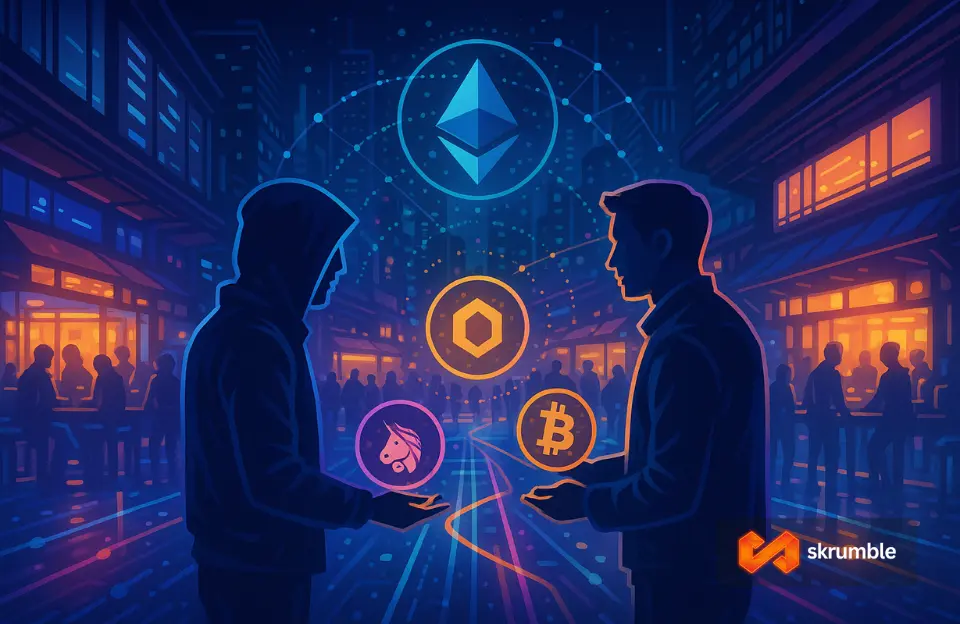
What is a rollup? A rollup is an Ethereum Layer 2 (L2) scaling solution that batches many transactions off-chain into a single compressed proof or summary, then posts that batch to Ethereum mainnet for final settlement. Users get the security guarantees of Ethereum (their funds are ultimately secured by the L1's economic security) while paying a small fraction of mainnet gas fees. The 2026 rollup landscape is the dominant L2 paradigm: approximately 73 active rollups across the Ethereum ecosystem hold roughly $48 billion in combined TVL. Arbitrum One leads with approximately $15.9-16.9 billion (~40-44% market share); Base, operated by Coinbase on the OP Stack, holds second position at $10.7-12.8 billion. Together, Arbitrum and Base account for approximately 77% of all L2 DeFi liquidity. OP Mainnet, Scroll, Linea, zkSync Era, World Chain, and Starknet round out the major venues. The two architectural families: optimistic rollups (Arbitrum, Optimism, Base, World Chain) and ZK rollups (zkSync, Scroll, Linea, Polygon zkEVM, Starknet). EIP-4844 (Dencun, March 2024) reduced average L2 fees by 80-90%, bringing typical transaction costs to $0.001-$0.05 across major rollups.
This guide on what is a rollup walks the mechanics, the optimistic-versus-ZK trade-off, the leading rollups in 2026, the EIP-4844 blob upgrade and its effects, the differences between rollups and sidechains, the user-side bridging and withdrawal workflow, and the honest risk landscape. For broader blockchain context, see our blockchain pillar guide; for the bridging workflow between mainnet and L2s, see how to bridge crypto.
What is a rollup in 2026?
A rollup operates as a separate execution environment that periodically posts transaction data and state commitments to Ethereum mainnet. Two execution components matter. First, the rollup's own sequencer accepts user transactions, orders them, executes them against rollup state, and produces blocks. Second, batches of transaction data are posted to Ethereum mainnet (as either calldata or, since EIP-4844, as cheaper blob data) along with a state root commitment. The mainnet contract verifies the batch is valid (via fraud proofs in optimistic rollups or validity proofs in ZK rollups), and funds withdrawn from the rollup are released only after this verification passes.
The result is L2-native transaction throughput and cost (tens of thousands of transactions per second on some designs; sub-cent fees on most) with L1 security inheritance. Live rollup data is tracked at L2Beat, the canonical L2 transparency dashboard. Total Ethereum L2 TVL reached approximately $48 billion across 73 active rollups by mid-2026.
How do optimistic rollups work?
Optimistic rollups assume transactions are valid by default and use fraud proofs to catch invalid ones. The rollup sequencer posts batched transaction data to mainnet without any cryptographic proof of correctness; the network then enters a 7-day "challenge period" during which anyone can submit a fraud proof showing the batch contains an invalid transaction. If a valid fraud proof is submitted, the offending batch is reverted and the dishonest sequencer is penalized. If no fraud proof appears within the challenge period, the batch is finalized.
The architectural trade-off: optimistic rollups have the best EVM compatibility (existing Ethereum smart contracts deploy nearly unchanged) and the lowest computational overhead during normal operation. The drawback is the 7-day withdrawal challenge window: native withdrawal of funds from an optimistic L2 to mainnet takes 7 days unless the user uses a third-party bridge that fronts the funds for a fee. The major optimistic rollups in 2026: Arbitrum One (the largest L2 by TVL), Arbitrum's documentation at docs.arbitrum.io; Base (Coinbase-operated, OP Stack); Optimism mainnet; World Chain (Worldcoin-operated, OP Stack).
How do ZK rollups work?
ZK rollups (zero-knowledge rollups, also called validity rollups) post a cryptographic proof along with each batch that mathematically demonstrates the batch is valid. The mainnet contract verifies the proof and immediately finalizes the batch; there is no challenge period because invalid batches simply cannot pass proof verification. The trade-off: generating the proofs requires substantial computation off-chain, and historically ZK rollups had weaker EVM compatibility (specialized languages like Cairo on Starknet, custom zkEVM circuits on others) that has materially improved through 2024-2026.
The major ZK rollups in 2026: zkSync Era, Scroll, Linea (ConsenSys), Polygon zkEVM, and Starknet (Cairo-based, the most architecturally distinct). The ZK rollup advantage on user UX: withdrawal back to mainnet typically takes a few hours rather than the 7-day optimistic window, and the cryptographic finality matches mainnet immediately rather than after a challenge period. ZK rollups also enable native privacy features that optimistic rollups cannot offer; for the underlying cryptographic context, see our zero-knowledge proof guide.
What are the leading L2 rollups in 2026?
Five rollups dominate the 2026 ecosystem by TVL.
- Arbitrum One: $15.9-16.9 billion TVL (40-44% market share), the largest L2 by deep margin. Optimistic rollup with the deepest DeFi ecosystem, broadest dapp deployment, and strongest network effects.
- Base: $10.7-12.8 billion TVL, second-largest L2. Coinbase-operated on the OP Stack; consumer-app traction (Friend.tech, Farcaster, on-chain social) drove rapid 2024-2025 growth.
- OP Mainnet: $1.7-1.9 billion TVL. The original Optimism deployment; ecosystem coordinator for the broader OP Superchain (Base, World Chain, and other OP Stack chains).
- zkSync Era: ZK rollup leader by TVL in the ZK category. Custom zkEVM with strong EVM-equivalent compatibility.
- Scroll, Linea, Polygon zkEVM, Starknet, World Chain: mid-tier rollups each holding $500M-$3B+ TVL with differentiated technical or ecosystem positioning.
The Optimistic-versus-ZK split: optimistic rollups (Arbitrum, Base, OP, World) hold approximately 80% of total L2 TVL through 2026, driven by EVM compatibility advantages and years of ecosystem compounding. ZK rollups have the technical-superiority argument and are gaining share, particularly in derivatives and high-frequency-data use cases where the validity-proof finality matters. L2Beat publishes live TVL, transaction-throughput, fee, and stage-classification data for all 73 active rollups.
What is EIP-4844 and how did it change rollups?
EIP-4844 (Dencun hardfork, March 2024) introduced "blob" data: a new transaction type designed specifically for rollup data posting. Blobs are temporary (Ethereum nodes delete blob data after approximately 18 days) and substantially cheaper than equivalent calldata, since they do not occupy permanent execution-trie storage. The result for users: average L2 fees fell 80-90% in the weeks following Dencun activation, bringing typical L2 transaction costs from $0.10-$2 down to $0.001-$0.05.
The next major upgrade, EIP-7594 (PeerDAS, scheduled for the Fusaka hardfork in 2026), will further scale rollup data capacity by an order of magnitude through data-availability sampling. The roadmap continues to prioritize rollup-centric scaling: Ethereum's stated long-term strategy is to handle approximately 100,000 transactions per second across the L1 + L2 stack via rollup throughput, with the L1 acting as the security and settlement layer rather than the execution layer. Documentation lives at ethereum.org's roadmap page.
What is the difference between a rollup and a sidechain?
Both are scaling solutions that move transaction execution off mainnet, but the security model differs fundamentally. A sidechain (Polygon PoS, BNB Smart Chain, Avalanche C-Chain) is an independent blockchain with its own validator set and security guarantees. Funds on a sidechain are secured by the sidechain's own consensus, not by Ethereum. If the sidechain's validators collude or are compromised, sidechain users lose funds; Ethereum cannot help.
A rollup posts batched transaction data back to Ethereum mainnet and inherits Ethereum's security (via fraud proofs or validity proofs). Funds bridged to a rollup are ultimately secured by Ethereum's economic security; if the rollup's sequencer or operator misbehaves, the L1 enforcement mechanism kicks in. This security inheritance is the structural reason rollups are now the dominant Ethereum scaling path. Sidechains remain in use for specific applications (gaming, certain DeFi, fast-finality use cases) but are no longer the recommended path for material value storage. For deeper bridge mechanics, see our bridging guide.
How do I use a rollup?
The user-side workflow has three parts. First, bridge funds from Ethereum mainnet (or another rollup) to the destination rollup. Native bridges (operated by the rollup team) take 10 minutes to 7 days depending on direction and rollup type; third-party crypto bridges (Across, Stargate, Hop) settle in seconds for a small fee. Second, configure the destination rollup in your wallet: MetaMask, Rabby, and other major wallets all support adding any rollup via the network configuration. Chainlist publishes verified RPC endpoints. Third, use dapps on the rollup as you would on mainnet; transactions cost a fraction of mainnet equivalent.
Withdrawal back to mainnet matters operationally. Optimistic rollups: 7-day native withdrawal challenge period. Most users use a third-party bridge (Across, Stargate) for a 0.05-0.3% fee to skip the 7-day wait. ZK rollups: a few hours of native withdrawal, materially faster. Both routes are common; the choice depends on amount and urgency. For per-rollup deeper detail, see L2Beat or the individual rollup documentation.
What are the risks of using rollups?
Five risk classes. Sequencer centralization: most production rollups currently run a single sequencer operated by the rollup team. A misbehaving or offline sequencer can censor transactions or refuse to process them; the L1 fallback (force-include transactions through mainnet) exists but adds friction. Bridge contract risk: rollup bridges hold large amounts of value; a bug in the bridge contract can drain funds (the 2022 Wormhole and Ronin bridge exploits cost over $700 million combined). Upgradeable proxy risk: rollup contracts on L1 are typically upgradeable by the rollup team's multisig or governance; a compromised upgrade key could change rollup behavior maliciously. L2Beat publishes a stage classification (Stage 0 / Stage 1 / Stage 2) that tracks how decentralized each rollup actually is on these dimensions.
State-availability risk: ZK rollups historically had the data-withholding-attack concern (validity proofs prove correctness but not that the data was published). EIP-4844 blob data on Ethereum mainnet substantially mitigates this for rollups that post data through blobs. Smart-contract risk on the rollup's own dapps: the same smart-contract risk classes that apply to mainnet apply to rollup deployments. The honest 2026 framing: rollup risk has materially declined as designs have matured, but rollups remain more experimental than Ethereum mainnet itself; sizing material capital exposure accordingly is the practical default.
Frequently asked questions
Are rollups safer than sidechains?
Generally yes, because rollups inherit Ethereum's economic security via fraud proofs or validity proofs. A sidechain relies on its own validator set; if that set is compromised, sidechain funds are at risk. A rollup's worst-case requires either a fraud proof not being submitted in time (for optimistic) or a cryptographic break of the proof system (for ZK). The 2026 L2Beat stage classification quantifies how close each rollup is to the "trust nothing but Ethereum" ideal.
Which rollup should I use?
Match rollup to use case. For DeFi with the deepest liquidity, Arbitrum One. For consumer apps and Coinbase integration, Base. For specific dapps with native deployments, follow the dapp (Uniswap is on multiple rollups; Aave is on multiple rollups). For ZK-rollup advantages (faster withdrawal, smaller proof footprint), zkSync Era, Linea, or Scroll. For the most advanced ZK design with provable execution, Starknet.
How much do L2 transactions cost?
Typical 2026 fees across major rollups: simple ETH transfer $0.001-$0.01; ERC-20 token transfer $0.005-$0.05; complex DeFi interaction $0.05-$0.50. These are 50-500x cheaper than equivalent mainnet transactions during normal congestion and 10-50x cheaper during heavy congestion. EIP-4844 (March 2024) drove the 80-90% fee reduction.
Can I lose money using a rollup?
Yes, in three scenarios. The rollup's bridge contract is exploited and bridge funds are drained. The rollup's centralized sequencer goes offline for an extended period and the L1 fallback fails to recover positions in time. A smart contract you interact with on the rollup is exploited. The structural rollup risks have declined materially through 2024-2026 as designs matured, but residual risk persists.
What is the difference between Optimism and Base?
Base is built on the OP Stack (the open-source framework Optimism developed) and is operated by Coinbase. Optimism is the original OP Stack deployment. The two share core technology but differ in operator, ecosystem focus (Base has stronger consumer-app traction; OP has broader DeFi history), and sequencer revenue. Funds on either can be bridged freely to the OP Superchain ecosystem.
What is a Stage 0, Stage 1, or Stage 2 rollup?
L2Beat's classification of rollup decentralization. Stage 0 means "training wheels on", the rollup team has full unilateral upgrade and operational control. Stage 1 introduces some decentralization (security council with delays on upgrades; permissionless fraud proofs). Stage 2 means the rollup operates with no special privileges; users can fully exit even if the team disappears. As of mid-2026, most production rollups are Stage 0 or Stage 1; Stage 2 remains aspirational for the major ones.
Do I need a different wallet for each rollup?
No. MetaMask, Rabby, and other major Ethereum wallets support any EVM-compatible rollup. Add the rollup as a custom network (or use chainlist.org's one-click add) and use the same wallet for mainnet plus all EVM rollups. Non-EVM rollups (StarkNet, certain Polygon CDK deployments) require dedicated wallets (Braavos, Argent X for StarkNet).
Will Ethereum stop using rollups eventually?
No, the opposite. Ethereum's stated long-term strategy is "rollup-centric" scaling, where L1 acts as a security and settlement layer while rollups handle the vast majority of execution. EIP-7594 PeerDAS and other planned upgrades through 2026-2027 are specifically designed to scale rollup capacity by orders of magnitude. The L2 share of total Ethereum transaction volume is expected to continue growing relative to L1 mainnet.
Frequently asked questions
Are rollups safer than sidechains?
Which rollup should I use?
How much do L2 transactions cost?
Can I lose money using a rollup?
What is the difference between Optimism and Base?
What is a Stage 0, Stage 1, or Stage 2 rollup?
Do I need a different wallet for each rollup?
Will Ethereum stop using rollups eventually?
Sources
- [1]L2Beat: Canonical Ethereum L2 TVL dashboard · L2Beat · accessed
- [2]Ethereum.org: Rollups + rollup-centric roadmap · Ethereum Foundation · accessed
- [3]Arbitrum: Official documentation · Offchain Labs / Arbitrum · accessed
- [4]Chainlist: Verified RPC endpoints for EVM rollups · Chainlist · accessed
More in Blockchain fundamentals
What is Blockchain? 2026 Complete Guide
What is blockchain? A 2026 guide to Layer 1 + Layer 2 architecture, PoW vs PoS consensus, real-world use cases beyond crypto, and the honest limitations.
What is a Smart Contract? 2026 Foundational Guide + Risks
What is a smart contract in 2026: programs that execute automatically on blockchains, EVM dominance, Solana SVM and Move alternatives, exploits and audit norms.
What is Tokenization? 2026 RWA + Tokenized Assets Guide
What is tokenization in 2026: $29B RWA market across Treasuries, private credit, equities, real estate; BlackRock, Apollo, Hamilton Lane lead institutional issuance.
What is a Zero Knowledge Proof? 2026 zk-SNARK + STARK Guide
What is a zero knowledge proof in 2026: cryptographic prove-without-revealing primitive, zk-SNARK vs zk-STARK trade-offs, ZK rollup scaling, ZK identity systems.
What is Bitcoin Mining? 2026 Post-Halving Guide
What is Bitcoin mining? 2026 post-halving: 3.125 BTC block reward, 800+ EH/s hashrate, sub-20 J/TH ASICs, retail-unprofitable + industrial-only economics.