

Synapse Protocol Review
Long-running bridge that routes through pools, mint-and-burn, CCTP or intents
Affiliate link · doesn't affect score · independent methodology
At a glance
Synapse has run since 2021 and still works at bridge.synapseprotocol.com. Its router picks between liquidity pools, mint-and-burn, Circle's CCTP and the Synapse Intent Network across 16+ chains and 8 tokens. Value locked has fallen to $9.65M from a $1.16B peak, and synapseprotocol.com now redirects to Hypercall. In November 2021 about $8M was drained from one of its pools; validators reversed the cross-chain mint.
Skrumble scoring breakdown
Read our full scoring methodology.
Quick stats
- Supported chains
- 16+
- Typical fee
- Not published; shown in the quote
- Avg. speed
- Not published
At A Glance
Who Is Synapse Protocol Best For?
Best for:
Users who want an established alternative route across more than 16 chains, with one app that picks between liquidity pools, mint-and-burn bridging, Circle's CCTP for native USDC and the Synapse Intent Network.
Skip if:
You want a bridge with published audits and growing liquidity. DefiLlama lists no audits for Synapse, its value locked has fallen to $9.65 million from a $1.16 billion peak, and synapseprotocol.com now redirects to Hypercall.
Our Take
Synapse has run since 2021 and still works at bridge.synapseprotocol.com. Its router picks between liquidity pools (nUSD and nETH), mint-and-burn bridging, Circle's CCTP for native USDC and the Synapse Intent Network, across more than 16 chains and 8 tokens.
It is also fading. Its value locked is $9.65 million, down from $1.16 billion in January 2022, and synapseprotocol.com now redirects to Hypercall, an options venue on Hyperliquid. Synapse does not publish its fees or transfer times, so check the quote in the app before you confirm.
In November 2021 an attacker drained about $8 million from one of its pools. Synapse's validators reversed the cross-chain mint and the team said liquidity providers would be made whole, but the episode also shows that a permissioned validator set signs transfers on the older pool and mint-and-burn routes.
Skrumble Scoring Breakdown
Our scoring weighs a working router with four route types and coverage of more than 16 chains against a November 2021 pool exploit, no audits listed on DefiLlama, unpublished fees and speeds, and value locked that has fallen to $9.65 million.
See our full crypto bridge scoring methodology here.
What is Synapse Protocol and How Does it Work?
Synapse Protocol is cross-chain infrastructure that enables asset transfers and swaps across multiple blockchain networks. Built as a solution to blockchain interoperability challenges, Synapse goes beyond simple token bridging by integrating automated market maker (AMM) functionality directly into the cross-chain transfer process.
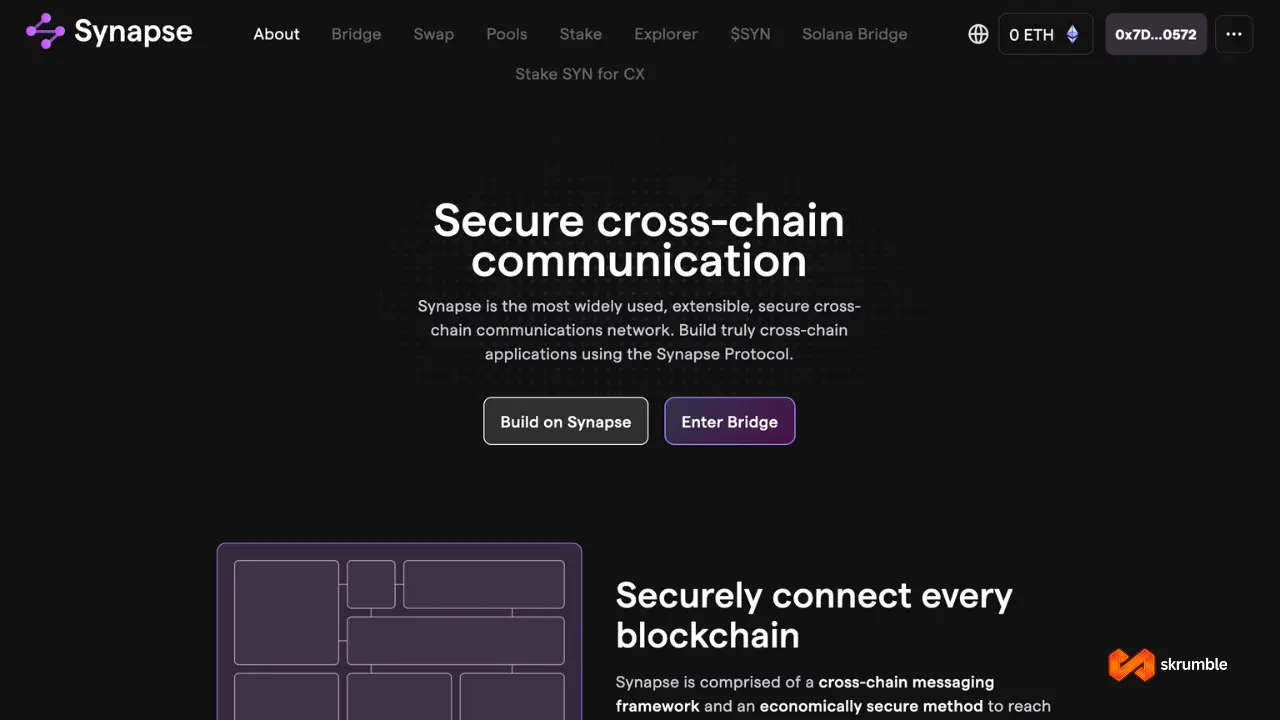
The protocol facilitates cross-chain transactions between Layer 1 and Layer 2 networks, enabling users to transfer assets between previously isolated blockchain ecosystems. For example, users can easily move assets from Avalanche to Polygon or Ethereum.
Technical Architecture:
On its pool routes, Synapse uses a cross-chain AMM (Automated Market Maker) system that converts tokens from one blockchain to native assets of the destination chain. This system leverages stable swap algorithms to determine optimal exchange prices for tokens within cross-chain liquidity pools, providing superior efficiency compared to traditional bridging methods.
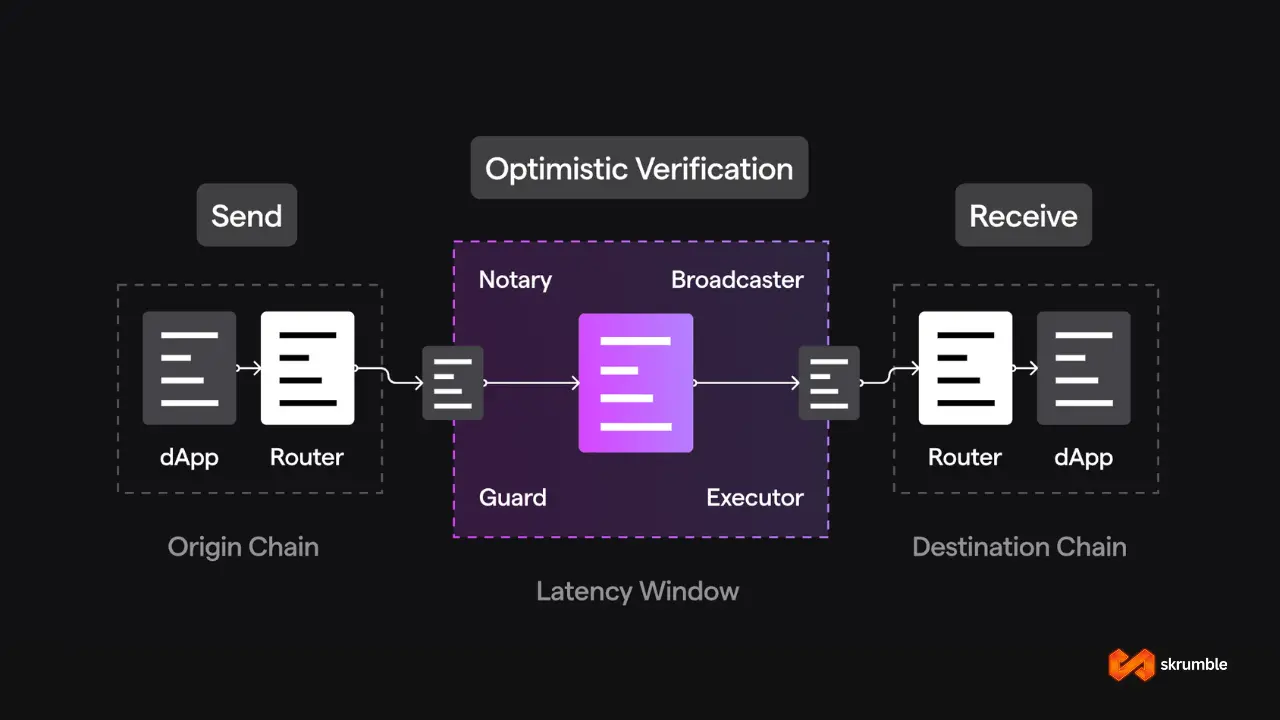
How a transfer is verified depends on the route. Pool and mint-and-burn transfers are signed by Synapse's validators, while the Synapse Intent Network uses optimistic verification: a relayer fronts the funds, then posts a proof that opens a dispute period. On pool routes, the system uses stableswap algorithms to determine optimal exchange rates within cross-chain liquidity pools, ensuring minimal slippage and efficient pricing.
Key Technical Components:
Which actors you rely on depends on the route. On the older pool and mint-and-burn routes, a validator set signs cross-chain transfers; in November 2021 those validators were able to reverse a cross-chain mint, which shows the set is permissioned. On the Synapse Intent Network (formerly RFQ, or FastBridge), relayers front the funds and off-chain Guards dispute any bad proof during the dispute period.
Bridging Mechanisms:
The Synapse Router picks one of four route types for a transfer:
- Canonical Token Bridging: Wrapped assets moved by mint-and-burn
- Liquidity-based Bridging: Assets swapped through the nUSD and nETH pools, which are backed by nexus pools on Ethereum
- CCTP: Native USDC moved through Circle's Cross-Chain Transfer Protocol
- Synapse Intent Network: A relayer fronts the funds and Guards can dispute its proof
Unique Features
Cross-Chain AMM Integration
Unlike traditional bridges that simply lock and mint tokens, Synapse integrates automated market maker functionality directly into the bridging process. This allows for more efficient price discovery and reduced slippage when swapping between different assets during cross-chain transfers.
Synapse Chain Explorer
The Synapse Chain Explorer stands as a generic event indexer for all Synapse Bridge events, representing one of the most comprehensive blockchain analytics tools in the cross-chain space. This advanced bridge explorer pairs powerful backend indexing with an intuitive user interface, providing users with complete visibility into every transaction that passes through the Synapse Bridge.
Real-Time Analytics and Monitoring:
The Explorer provides real-time comprehensive overview of bridging transactions, cross-chain messaging, and general network analytics. The transaction data displayed is extremely legible and can be parsed by token, chain, address, transaction hash, and numerous other parameters, making it easy for both casual users and advanced analysts to find the information they need.
Data Accessibility and API:
All information collected by the Synapse Explorer is stored in a publicly accessible API, meaning anyone can access the data and run their own analytics. This open approach enables third-party developers to build additional tools and services on top of Synapse's infrastructure, fostering a broader ecosystem of cross-chain applications.
User-Friendly Features:
The Explorer includes several advanced tools that help users easily access transaction information:
- Advanced Search Bar: Filter transactions by token, address, chain, or any combination of parameters
- Transaction Status Tracking: Real-time updates on transaction progress across chains
- Recent Activity Monitoring: Live feed of recent bridge activity
- Analytics Views: Comprehensive data segmented by origin chain, destination chain, address, and tokens
- Volume Metrics: Access to advanced volume data, total transaction counts, and user metrics
- Historical Data: Complete transaction history since protocol launch
Developer and Protocol Benefits:
Beyond user-facing features, the Synapse Explorer serves critical functions for protocol maintenance and development. The Synapse team and developers use the Explorer for debugging and troubleshooting problems with the Synapse Bridge and applications built on it.
The ability to gather data on every cross-chain message transmitted provides developers with valuable insights into user behavior patterns. This helps identify areas for improvement, optimize user experience, and ensure applications perform effectively across different network conditions.
Technical Infrastructure Suite:
The Synapse Explorer operates on an advanced data indexing suite that Synapse intends to make open source, enabling other projects to leverage these tools:
- OmniRPC: An RPC aggregator used to interface across all supported chains. The number of confirmations required across RPCs to produce valid results is configurable, ensuring data integrity while maintaining performance.
- Scribe: This critical component indexes and stores Receipts, Logs, Transactions, and Blockheader data for over 860 contracts across 18+ chains. Built with robust record protection mechanisms, Scribe ensures data integrity and provides the foundation for all Explorer functionality.
- Explorer Backend: Responsible for parsing raw data from events emitted by Synapse contracts across all supported platforms. This includes processing historical token data, calculating maturity data with historical prices, and providing the clean, structured data that users see in the interface.
Impact on Cross-Chain Ecosystem:
The comprehensive nature of the Synapse Explorer sets a new standard for transparency in cross-chain protocols. By providing complete visibility into all bridge operations, it builds user confidence and enables sophisticated analysis that wasn't previously possible in the cross-chain space.
Stableswap Algorithm
Synapse uses an advanced stableswap algorithm optimized for cross-chain liquidity pools. This provides better pricing efficiency compared to traditional constant product formulas, especially for stablecoin transfers.
Supported Networks and Assets
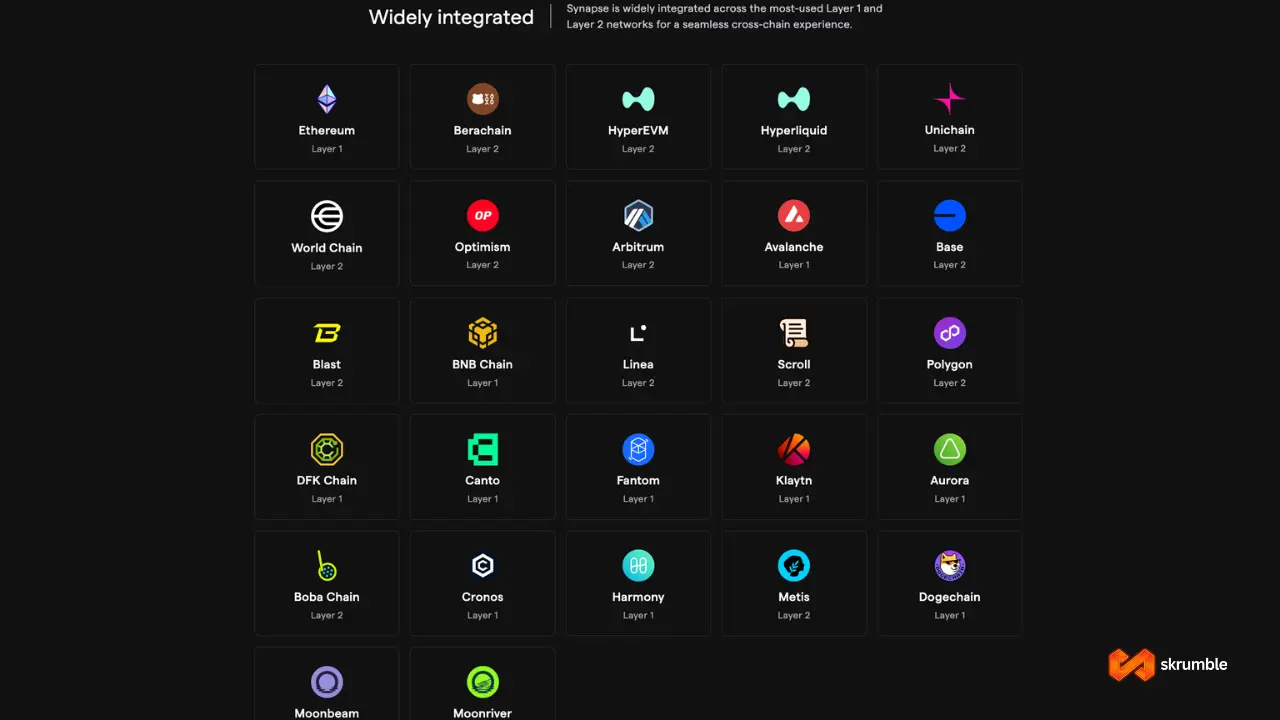
Synapse's bridge page lists more than 16 blockchain networks and 8 bridge tokens. On 9 October 2026 DefiLlama showed funds on 12 chains, while seven others it tracks for Synapse, including Harmony, Moonbeam and Cronos, held none.
Layer 1 Networks:
- Ethereum: The foundational network with full feature support
- BNB Chain: Comprehensive integration with Binance ecosystem
- Avalanche: Full C-Chain compatibility with high throughput
- Additional L1s: Including various emerging networks
Layer 2 and Scaling Solutions:
- Arbitrum: Leading Ethereum L2 with extensive DeFi ecosystem
- Optimism: Optimistic rollup with growing adoption
- Polygon: Ethereum scaling with established infrastructure
- Base: Coinbase's L2 solution gaining significant traction
- Additional L2s: Covering most major Ethereum scaling solutions
Asset Coverage (8 Bridge Tokens):
The bridge page lists 8 tokens: USDC, USDT, ETH, nETH, SYN, DAI, FRAX and USDB.
Major Cryptocurrencies:
- ETH (Ethereum): Native and wrapped versions across chains
- SYN (Synapse Token): Protocol's native governance token
Stablecoins:
- USDC (USD Coin): Most liquid stablecoin option
- USDT (Tether): Widely accepted across all networks
- DAI (MakerDAO): Decentralized stablecoin option
- FRAX and USDB
Synapse Native Assets:
- nETH: Synapse's cross-chain ETH representation
nUSD: Cross-chain stablecoin optimized for Synapse pools
Pool backing: The nUSD and nETH pools are backed by nexus pools on Ethereum, and native USDC can also move through Circle's CCTP instead of a pool.
Asset Bridging Methods:
Different assets use different bridging mechanisms based on their characteristics:
- Native assets like ETH use liquidity pools for efficient transfers
- Stablecoins use Synapse's stableswap pools, while native USDC can also go through Circle's CCTP
- Governance tokens typically use canonical bridging for maximum security
- Protocol-specific tokens may have custom bridging logic
Current Direction:
Synapse is shrinking rather than expanding. DefiLlama puts its value locked at $9.65 million on 9 October 2026, down from $41.8 million a year earlier and a peak of $1.16 billion in January 2022, and synapseprotocol.com now redirects to Hypercall, an options venue on Hyperliquid. The bridge itself still runs at bridge.synapseprotocol.com.
Fees Structure
Synapse does not publish a fee schedule. Fees are dynamic, and the app shows the total in the quote before you confirm. The cost types below are a general guide, not published rates.
Primary Fee Components:
- Synapse Service Charge Synapse charges a fee for facilitating cross-chain transfers. The rate is not published; it is dynamic and appears in the quote.
- Blockchain Network Fees (Gas Fees) You pay gas on the source chain, and on some routes on the destination chain too. Ethereum gas was about 0.1 gwei on 9 October 2026, so a bridge transaction there cost cents.
3. Liquidity Provider Costs When asset swaps involve transfers between different asset types, additional fees may be charged by liquidity providers to facilitate the swap. These fees compensate LPs for providing the necessary liquidity and taking on impermanent loss risk.
Synapse does not publish its pool fees; they are part of the quoted total.
- Additional Variable Costs
- Arbitrage Costs: During complex transactions involving smart contract interactions
- Slippage Fees: For large transactions that may impact pool prices
Fee Estimation and Transparency
The Synapse interface shows the fee in the quote before you confirm. Because Synapse publishes no fee schedule, that quote is the only reliable number, so read it every time.
Reality Check on Fees:
All fees fluctuate based on current market conditions, so costs can vary significantly between transactions. During high network congestion periods, gas fees can increase dramatically, making smaller transfers uneconomical. Users should always verify current fee estimates before proceeding with transactions.
Fee Optimization Strategies:
- Timing: Monitor network congestion to find optimal transfer windows
- Route Selection: Some network pairs offer better fee efficiency
- Transaction Size: Larger transfers have better fee-to-value ratios
- Asset Choice: Some tokens have lower bridging costs than others
Competitive Analysis:
Synapse publishes no fees and we could not capture a like-for-like quote, so we can't say whether it costs more or less than the other bridges in our ranking of the best crypto bridges. Compare its quote with another bridge before a large transfer.
Security and Safety
In November 2021 an attacker exploited a bug in code forked from Saddle to drain about $8 million from Synapse's Avalanche nUSD metapool. Synapse's validators reversed the cross-chain mint, and the team said liquidity providers would be made whole. The same bug cost Nerve Bridge about $537,000. Security today depends on the route: the pool and mint-and-burn routes are signed by a permissioned validator set, while the Synapse Intent Network uses optimistic verification, with off-chain Guards disputing bad relayer proofs.
Security Measures:
- Audits: none listed on DefiLlama, and we found no audit list in Synapse's docs
- Optimistic verification with a dispute period on the Synapse Intent Network
- Off-chain Guards that dispute bad relayer proofs
- Validator-signed transfers on the pool and mint-and-burn routes
Track Record: Synapse has run since 2021. Its November 2021 exploit is described above, and its value locked has since fallen to $9.65 million, so send a small test transfer before a large one.
SYN Token
The SYN token serves as the comprehensive governance and utility token for the entire Synapse ecosystem. As an Ethereum-based ERC-20 token, SYN powers various critical protocol functions while providing holders with governance rights and earning opportunities.
Comprehensive Use Cases
- Governance and DAO Participation SYN token holders possess voting rights in the SynapseDAO, enabling them to participate in crucial protocol decisions including:
- Protocol parameter adjustments
- New network integration proposals
- Fee structure modifications
- Treasury management decisions
- Future development priorities
Active stakeholders and liquidity providers drive protocol governance, ensuring community-driven development that reflects actual user needs.
- Liquidity Incentives and Rewards The token functions as a primary liquidity incentive mechanism. Liquidity providers receive SYN rewards for their contributions to Synapse pools, encouraging deep liquidity across all supported networks.
Token Economics and Distribution
Total Supply: 250,000,000 SYN tokens (fixed maximum supply)
Initial Distribution Breakdown:
- SYN Genesis Airdrop: 62% (155,000,000 SYN)
- Future Distribution: 26.8% (67,000,000 SYN)
- Prior Distribution to Liquidity Providers: 7.8% (19,500,000 SYN)
- Synapse Protocol Owned Liquidity: 2.2% (5,500,000 SYN)
- SynapseDAO Loan to Market Makers: 1.2% (3,000,000 SYN)
Historical Background
Synapse Protocol originally launched as Nerve (NRV) on the BNB Chain before evolving into the current multi-chain protocol. The token migrated from NRV to SYN in 2021 at a conversion rate of 1 NRV = 2.5 SYN, reflecting the protocol's expanded scope and capabilities.
Adding SYN to a Wallet
MetaMask Integration: Users can easily add SYN to MetaMask wallets by:
- Copying the official contract address
- Using one-click addition through platforms like CoinGecko
- Manual import through MetaMask's token addition interface
This accessibility enables users to easily track holdings and participate in decentralized exchange trading directly from their wallets.
User Experience and Interface
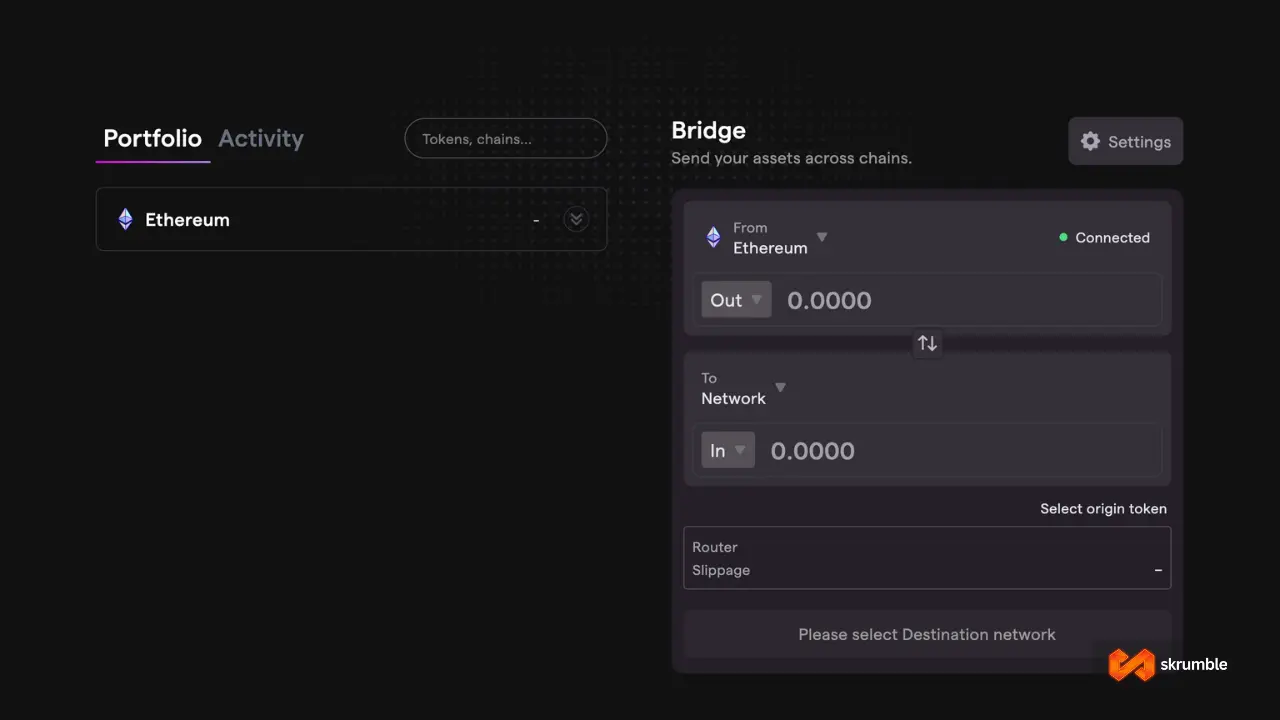
Synapse Protocol provides a clean, intuitive interface that makes complex cross-chain operations accessible to users of all experience levels. The platform successfully balances advanced functionality with user-friendly design, though some features require blockchain knowledge to fully utilize.
Interface Design
The main Synapse interface features a streamlined design focused on the core bridging functionality. Users can easily select source and destination networks, choose assets, and preview transaction details before confirmation. The interface provides clear visual feedback throughout the process, including the fee for your route.
Transaction Flow
- Network Selection: Clear dropdown menus for source and destination chains
- Asset Selection: Comprehensive list of supported tokens with current balances
- Amount Input: Simple input field with balance checking and maximum buttons
- Fee Preview: The fee shown in the quote before confirmation
- Transaction Confirmation: Clear summary with final amounts and estimated timing
Advanced Features
For experienced users, the platform offers advanced routing options that can optimize for different priorities:
- Fastest Route: Minimizes transaction time
- Cheapest Route: Optimizes for lowest fees
- Best Rate: Maximizes received amount after all fees
Mobile Compatibility
The Synapse interface is fully responsive and mobile-optimized, enabling users to perform cross-chain transfers from any device. The mobile experience maintains all desktop functionality while adapting to smaller screens effectively.
Educational Resources
Recognizing the complexity of cross-chain operations, Synapse provides comprehensive educational materials including:
- Step-by-step bridging guides
- Network-specific tutorials
- Fee explanation documentation
- Troubleshooting resources
- Video walkthroughs for common operations
Things We Do Not Like about Synapse Protocol
Based on our analysis of the Synapse bridge, these limitations are worth considering:
- Limited Network Scope Compared to Competitors
While Synapse lists more than 16 networks and 8 bridge tokens, this represents a more limited selection compared to some competitors like Portal Bridge (30+ chains claimed) or Stargate Finance. Users requiring access to newer or more specialized networks may find Synapse insufficient for their needs.
- Complex Fee Structure Creates Unpredictability
The dynamic fee structure, with no published schedule, can make cost prediction challenging, especially for new users. Unlike bridges with simple flat fees, Synapse's variable pricing model means transaction costs can fluctuate significantly between attempts, making budgeting difficult.
- Validator Dependency Concerns
The pool and mint-and-burn routes rely on a permissioned validator set. In November 2021 those validators were able to reverse a cross-chain mint during an exploit, which shows that on those routes you are trusting the signers.
- Learning Curve for Advanced Features
While basic bridging is straightforward, fully utilizing Synapse's AMM integration and advanced routing requires significant DeFi knowledge. New users may find themselves overwhelmed by options and uncertain about optimal choices.
- Shrinking Liquidity
Synapse's value locked fell from $41.8 million to $9.65 million in the year to 9 October 2026 (DefiLlama), seven chains DefiLlama tracks for it now hold no funds, and synapseprotocol.com now redirects to Hypercall. Use bridge.synapseprotocol.com and bookmark it.
- Documentation Gaps
We found no fee schedule, transfer times or audit list in Synapse's docs, and DefiLlama lists no audits, so the in-app quote is the only cost figure you can check.
These limitations don't invalidate Synapse's value proposition but represent areas where competing solutions might better serve specific user needs.
Conclusion
Synapse has been live since 2021, and its router still offers four ways to move funds: liquidity pools, mint-and-burn, Circle's CCTP and the Synapse Intent Network. The bridge still works at bridge.synapseprotocol.com.
It is also a project in decline. Value locked has dropped to $9.65 million from a $1.16 billion peak, the main domain now points to Hypercall, and we found no published fees, speeds or audits. When one of its pools was exploited in November 2021, it was a permissioned validator set that reversed the cross-chain mint.
Bottom Line
Synapse is an established alternative for the 8 tokens it supports, not a first choice. If you use it, go through bridge.synapseprotocol.com, send a small test amount first and compare the quote with another bridge before a large transfer.
Skrumble Community Ratings
We're building our Synapse Protocol review section! Share your experience to help others, particularly regarding:
- Your experience with different supported networks
- How fees compare to other cross-chain bridges
- Transaction speeds and any delays encountered
- Security incidents or concerns
- Customer support quality and responsiveness
- DeFi integration experiences
FAQs
Is Synapse Protocol Safe?
+Synapse still works, but it carries more risk than most bridges we rank. In November 2021 an attacker drained about $8 million from one of its pools; the validators reversed the cross-chain mint and the team said liquidity providers would be made whole. Its pool and mint-and-burn routes depend on a permissioned validator set, DefiLlama lists no audits, and its value locked has fallen to $9.65 million. Send a small test transfer first.
What chains does Synapse support?
+Synapse supports more than 16 networks, including Ethereum, BNB Chain, Avalanche, Polygon, Arbitrum and Optimism, and 8 bridge tokens: USDC, USDT, ETH, nETH, SYN, DAI, FRAX and USDB.
How much does it cost to use Synapse?
+Synapse doesn't publish a fee schedule. Fees are dynamic and shown in the quote before you confirm, and you also pay network gas.
What is the SYN token used for?
+SYN serves as the governance and utility token, used for voting in SynapseDAO and for liquidity incentives in Synapse pools.
How long do transfers take?
+Synapse doesn't publish transfer times. Timing depends on the route (pool, mint-and-burn, CCTP or intent) and the chains involved, so send a small test transfer first if timing matters.
Risk Warning:
Trading Forex, CFDs, and cryptocurrencies carries a high level of risk and may not be suitable for all investors. These markets are volatile and can result in the loss of your invested capital. Make sure you fully understand the risks before trading.
Screenshots captured during testing