What is an NFT? 2026 Honest Guide
What is an NFT? Honest 2026 guide: market down 79% from peak, surviving use cases (gaming 38%, ticketing 5.3%, RWA $2.3B), Blur vs OpenSea, real risks.
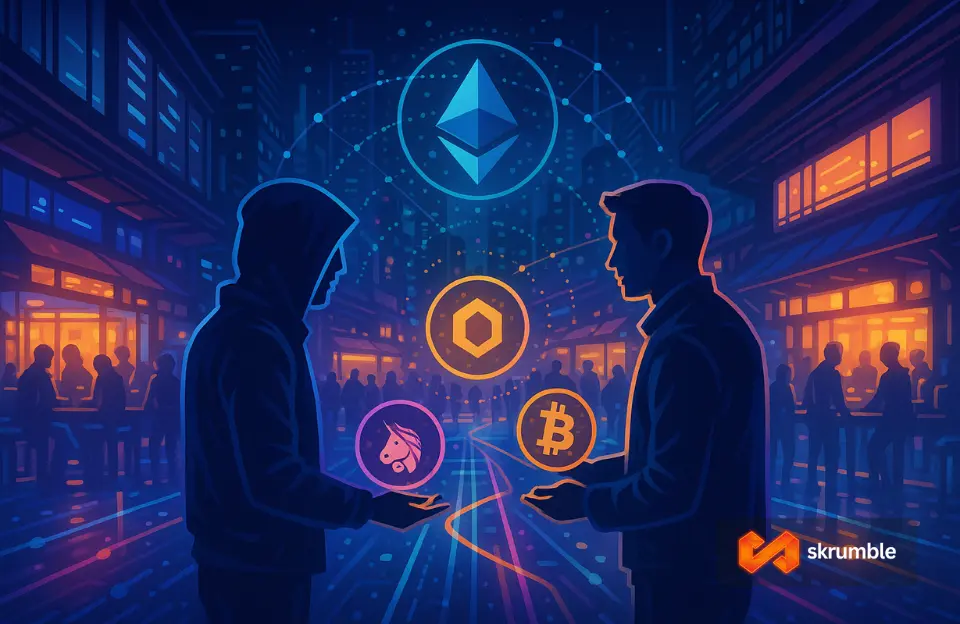
What is an NFT? An NFT (non-fungible token) is a blockchain-recorded token that represents ownership of a unique item, digital art, an in-game asset, an event ticket, a tokenized real-world asset, or a domain name. Unlike Bitcoin or USDC where every unit is interchangeable, each NFT has a distinct identifier that makes it different from every other NFT in its collection. The 2026 NFT market is structurally different from the 2021-2022 speculative peak. Monthly Ethereum NFT trading volume sits at approximately $720 million, down 79% from the 2022 peak of $3.5 billion. Active wallets settled at 505,000 (42% of the 2022 high-water mark). What survived the crash: gaming (38% of total NFT volume on Immutable X, Polygon, and Ronin), event ticketing (5.3% of the US market with on-chain fraud reduction), and real-world-asset tokenization (real estate at $1.4 billion, luxury fashion at $890 million). What died: PFP-driven speculation, brand-collaboration drops (Nike RTFKT, Reddit Collectible Avatars, Nifty Gateway all exited), and most generative art collections. The honest 2026 framing: NFTs as infrastructure for digital ownership in specific use cases, not as a speculative asset class.
The NFT meaning at the technical level: a unique blockchain-recorded token with a distinct identifier (typically ERC-721 or ERC-1155 on Ethereum). This guide answers what a 2026 user actually needs about what is an NFT: the mechanical model, the difference from fungible tokens, NFT examples spanning gaming and ticketing and real-world assets, the surviving use cases backed by 2026 data, how to buy and mint, the major marketplaces, tax treatment, and an honest risk inventory including the post-2022 reality. Every figure is sourced to a primary citation in the footer.
What is an NFT in 2026?
An NFT is a unique token on a blockchain. The "non-fungible" part means each token is distinguishable from every other token: NFT #42 in a collection is not interchangeable with NFT #43, even though both come from the same contract. This contrasts with fungible tokens like Bitcoin, ETH, or USDC where one unit is exactly equivalent to another.
The technical implementation in 2026 dominates around two Ethereum standards: ERC-721 (each token is unique with its own ID) and ERC-1155 (allows both unique and semi-fungible tokens in one contract, used heavily in gaming). Solana NFTs use the Metaplex standard. Bitcoin Ordinals (introduced January 2023) inscribe data onto individual satoshis, producing Bitcoin-native NFTs.
For broader context on how blockchains record this kind of digital ownership, see our blockchain pillar guide.
How do NFTs work mechanically?
Walk through a typical NFT lifecycle:
- A creator deploys an NFT smart contract on a blockchain (Ethereum, Polygon, Solana, Arbitrum, Base). The contract defines the collection's properties: name, symbol, maximum supply, metadata structure.
- The creator (or a buyer during mint) calls the contract's mint function. This creates a new token within the collection with a unique token ID and assigns ownership to the buyer's wallet address.
- The token's metadata (the actual image, description, traits) is typically stored off-chain on IPFS, Arweave, or a centralized server. The blockchain stores a pointer to the metadata, not the metadata itself.
- The owner can transfer, sell, or use the token. Transfers update the on-chain ownership record. Sales typically happen through marketplaces (OpenSea, Blur, Magic Eden) that match buyers and sellers.
- Royalties (the percentage paid to the creator on each resale) were initially enforced by marketplace policy. In 2026, royalty enforcement is largely voluntary or marketplace-specific because zero-royalty marketplaces (Blur, X2Y2) demonstrated that pure on-chain enforcement was impossible.
The metadata-off-chain detail matters because it is a structural weakness. If the IPFS pin lapses or the centralized server goes down, the NFT's image and traits disappear even though the token still exists on-chain. Arweave's "permaweb" model addresses this by paying for permanent storage upfront; quality collections in 2026 increasingly use Arweave.
What is the difference between NFTs and fungible tokens?
| Property | Fungible tokens (BTC, ETH, USDC) | NFTs (ERC-721, ERC-1155) |
|---|---|---|
| Identity | Every unit is identical and interchangeable | Each token has a unique ID and may have unique metadata |
| Divisibility | Divisible to small fractions (8 decimal places for BTC, 18 for ETH) | Indivisible (you can't own half an NFT, though fractional-NFT protocols exist) |
| Standard | ERC-20 (Ethereum), SPL (Solana), BEP-20 (BNB Chain) | ERC-721 + ERC-1155 (Ethereum), Metaplex (Solana), Ordinals (Bitcoin) |
| Use case | Money, settlement, store of value, governance | Digital ownership of unique items: art, game assets, tickets, RWAs |
| 2026 example | 1 USDC = 1 USDC (regardless of which one) | CryptoPunk #7804 ≠ CryptoPunk #6529 (different traits, different prices) |
For stablecoin specifics, see our stablecoin pillar guide; for DeFi context where both token types interact, see our DeFi pillar guide.
What are the main NFT use cases in 2026?
The 2026 NFT landscape has consolidated around specific use cases that delivered real utility. The breakdown by share of total NFT activity:
- Gaming (38% of NFT volume). NFTs as in-game items with verifiable scarcity and cross-game portability. Immutable X dominates Ethereum-aligned gaming NFTs; Polygon and Ronin (Axie Infinity's L1) handle the rest. Gaming NFT transaction counts grew 140% year-over-year through 2025-2026 despite the broader market correction.
- Real-world asset tokenization (substantial growth). Real estate NFTs hold approximately $1.4 billion in tokenized property representation. Luxury fashion NFTs (authentication and ownership records for high-end goods) sit at $890 million. The broader RWA category, including BlackRock's BUIDL, Ondo's USDY, and Circle's USYC tokenized Treasuries, grew from $170 million to $2.7 billion in 2025.
- Event ticketing (5.3% of US market). NFT-based tickets eliminate counterfeiting through on-chain provenance and enable resale royalties for event organizers. Companies like Token.com and YellowHeart deploy NFT ticketing for concerts and sports events.
- Digital identity and credentials. Soulbound (non-transferable) NFTs serve as verifiable credentials: academic degrees, professional certifications, KYC attestations. The Ethereum Foundation's Decentralized Identity work and Microsoft's ION are infrastructure for this.
- Domain names. ENS (Ethereum Name Service) names like vitalik.eth are NFTs. ENS has approximately 2.5 million active registrations as of early 2026.
- Digital art and collectibles (declining). Still active on OpenSea and Magic Eden but a fraction of the 2021-2022 share. Surviving collections tend to be either historically significant (CryptoPunks, Art Blocks) or actively developed by their teams (Pudgy Penguins).
How do I buy an NFT?
The buy NFT path is straightforward but jurisdiction-sensitive and chain-dependent. Foundational NFT documentation is at ethereum.org/nft. The mechanical steps:
- Buy ETH on a regulated exchange (Coinbase, Kraken, or Binance) and withdraw to a self-custodial wallet (MetaMask, Rabby, Frame). For Solana NFTs, use Phantom. See our wallet pillar guide for the wallet decision tree.
- Bridge to the chain that hosts your target collection if it's not on Ethereum mainnet. Polygon, Arbitrum, Base, and Immutable X each host major NFT collections. See our bridge guide for the cross-chain routes.
- Navigate to a major marketplace (OpenSea, Blur, Magic Eden for Solana). Verify the URL through official documentation, phishing marketplaces are a recurring vector.
- Connect your wallet to the marketplace. Browse or search for the collection you want.
- For a specific NFT: place a bid (offer your price), make an instant purchase at the listed price, or submit a collection-wide offer that any holder can accept.
- Confirm the transaction in your wallet. Pay attention to the gas estimate and the royalty + marketplace fee disclosure.
- The NFT appears in your wallet's NFT section once the transaction confirms. View it on the marketplace, in your wallet, or on a block explorer.
What are the best NFT marketplaces in 2026?
- Blur. Captures approximately 38% of Ethereum NFT volume in early 2026. Positioned as a DeFi-integrated trading terminal for professional traders. NFT lending, perpetuals, and portfolio management alongside spot trading. Zero-royalty by default.
- OpenSea. Reclaimed approximately 40% market share by late 2025. Pivoted heavily toward fungible-token aggregation; over 90% of OpenSea's 2026 volume is now fungible tokens rather than traditional NFTs. Still the consumer-friendly marketplace for new entrants.
- Magic Eden. The dominant Solana NFT marketplace. Multi-chain expansion to Ethereum, Polygon, and Bitcoin Ordinals.
- X2Y2. Ethereum NFT marketplace with active trading-rewards program. Zero-royalty by default.
- Tensor. Solana NFT marketplace focused on pro-trader UX with portfolio management and analytics.
- Foundation, SuperRare, Knownorigin. Curated digital-art marketplaces with editorial gating; smaller volume but higher per-piece average.
The 2026 marketplace landscape rewards either pro-trader infrastructure (Blur, Tensor) or chain-specialized leadership (Magic Eden on Solana). Generalist consumer marketplaces (OpenSea, X2Y2) face structural pressure as their volume shifts to fungible-token aggregation.
How are NFTs created and minted?
Minting an NFT means deploying or interacting with a smart contract that creates new tokens. Two approaches:
- Use a no-code platform. OpenSea's Studio, Manifold, Crossmint, and Async Art let creators upload art and deploy a collection without writing code. Manifold's Creator Contracts are the standard for one-off art drops; Async Art handles programmable art with dynamic traits.
- Deploy a custom contract. Solidity developers can deploy ERC-721 or ERC-1155 contracts directly. OpenZeppelin's audited contract templates are the starting point; the contract typically includes minting, royalty, and metadata-URI logic.
Costs as of 2026: Ethereum L1 deployment costs $50-300 in gas depending on contract complexity and gas prices. Each mint to a user costs $1-15 in gas. L2 deployment (Polygon, Arbitrum, Base) costs cents. Solana minting costs fractions of a cent per token.
For metadata storage, IPFS is the standard option (pin with Pinata or NFT.Storage). Arweave provides permanent storage paid upfront and is increasingly preferred for serious collections.
How are NFTs taxed?
NFT taxation varies by jurisdiction. The general pattern in major economies (US, UK, EU):
- Buying with crypto. A taxable disposal of the crypto used to buy. The user realizes gain or loss on the ETH (or other crypto) measured against the ETH's cost basis at the moment of the NFT purchase.
- Selling an NFT. A taxable disposal of the NFT. Gain or loss measured against the NFT's cost basis (including the fiat value of the crypto paid at acquisition plus gas and fees).
- NFT-to-NFT swap. Treated similarly to a sale and purchase in most jurisdictions.
- Royalties (creator side). Income at fair market value on receipt in most jurisdictions.
- US specifically. The IRS issued guidance in 2023 indicating some NFTs may be treated as "collectibles" with the higher 28% long-term capital gains rate (vs the standard 20% top rate). The Form 1099-DA reporting framework introduced in 2025 covers NFT broker activity.
For Singapore-specific framework see our Singapore crypto tax guide; for Canadian context see our Canada crypto bank guide.
What killed NFT speculation in 2022-2024?
The 2021-2022 NFT bubble peaked in early 2022 with Ethereum NFT volume above $3.5 billion monthly. By mid-2024, volume had collapsed to approximately $480 million. The drivers:
- Macro environment. The broader 2022 crypto bear market (Terra UST collapse May 2022, Three Arrows June 2022, Celsius July 2022, FTX November 2022) removed speculative capital across the board.
- Royalty erosion. Marketplace competition led to zero-royalty trading (Blur launched 2022 and reached major volume share by 2023). Creators lost the revenue model that supported active development of collections.
- Brand exits. Nike's RTFKT, Reddit Collectible Avatars, and Nifty Gateway all wound down operations through 2024-2025. Brand-collaboration drops lost credibility.
- Wash trading. A significant portion of 2021-2022 volume was wash trading to farm marketplace token incentives. Once the incentives stopped, the volume disappeared.
- Art-utility mismatch. Many PFP collections promised utility (gated communities, future games, merchandise) that never materialized. Holders absorbed the loss.
- Marketplace consolidation. SuperRare lost share to OpenSea; many smaller marketplaces shut down entirely; the few survivors operate at a fraction of peak volume.
The 2026 survivor pattern: utility-backed use cases (gaming, ticketing, RWA, identity) grew through the downturn; pure-speculation collections did not. The lesson is that NFTs work as a technology when they solve a specific ownership problem, not as a self-referential investment thesis.
What are the real risks of buying NFTs in 2026?
- Illiquidity. Even popular collections trade with wide bid-ask spreads. Selling an NFT for the listed floor price often takes days; selling for a specific bid takes longer. Position-size accordingly.
- Marketplace failure. When a marketplace shuts down, your NFTs still exist on-chain but become hard to trade. Nifty Gateway and several smaller marketplaces have wound down through 2024-2025.
- Metadata loss. IPFS pins lapse; centralized metadata servers go offline; the underlying image or attributes can disappear even though the token remains. Verify the metadata is stored on Arweave or pinned reliably before paying premium prices.
- Phishing and theft. NFT-targeted phishing (fake mint sites, malicious "approve" transactions, compromised Discord servers) accounts for a substantial share of NFT loss. Verify URLs through official channels; review approval transactions before signing.
- Royalty disputes. A purchase on a zero-royalty marketplace deprives the creator. Some collections respond by blocking zero-royalty trading via on-chain enforcement, which can render NFTs untradeable on certain venues.
- Tax complexity. Every NFT trade is a taxable event in most jurisdictions; the cost-basis tracking is more complex than for fungible tokens because each NFT has its own basis.
- Smart-contract risk. NFT contracts have bugs. The Akutars 2022 incident locked $33M in ETH due to a withdrawal-function bug. Use audited contract patterns when minting; avoid unaudited contracts for high-value collections.
- Speculative valuation. Even surviving collections trade at multiples that may not reflect underlying utility. The 2026 market is more rational than 2021, not entirely rational.
Frequently asked questions
Auto-rendered from the data contract.
Frequently asked questions
What is an NFT in simple terms?
How do NFTs work?
What are NFT examples?
What are the main NFT use cases in 2026?
Where can I buy NFTs?
How are NFTs created?
Why did the NFT market crash in 2022-2024?
Are NFTs safe to invest in?
Sources
- [1]Ethereum.org: Non-fungible tokens (NFT) documentation · Ethereum Foundation · accessed
- [2]EIP-721: Non-Fungible Token Standard · Ethereum Improvement Proposals · accessed
- [3]EIP-1155: Multi Token Standard · Ethereum Improvement Proposals · accessed
- [4]Immutable X: Ethereum-aligned gaming NFT infrastructure · Immutable · accessed
- [5]Arweave: Permanent storage protocol for NFT metadata · Arweave · accessed
More in NFTs, DAOs & airdrops
What is a DAO? 2026 Decentralized Autonomous Org Guide
What is a DAO in 2026: $26B+ on-chain treasuries, Uniswap + Sky + Optimism + Arbitrum + Lido top 5, governance lifecycle, legal frameworks, and risks.
What is an Airdrop? 2026 Crypto Airdrop Guide + Top Drops
What is a crypto airdrop in 2026: Hyperliquid HYPE $10.8B peak, EigenLayer $1.1B, JTO $8-20K per user, points farming, scam patterns, and US tax treatment.