
What is a Smart Contract? 2026 Foundational Guide + Risks
What is a smart contract in 2026: programs that execute automatically on blockchains, EVM dominance, Solana SVM and Move alternatives, exploits and audit norms.
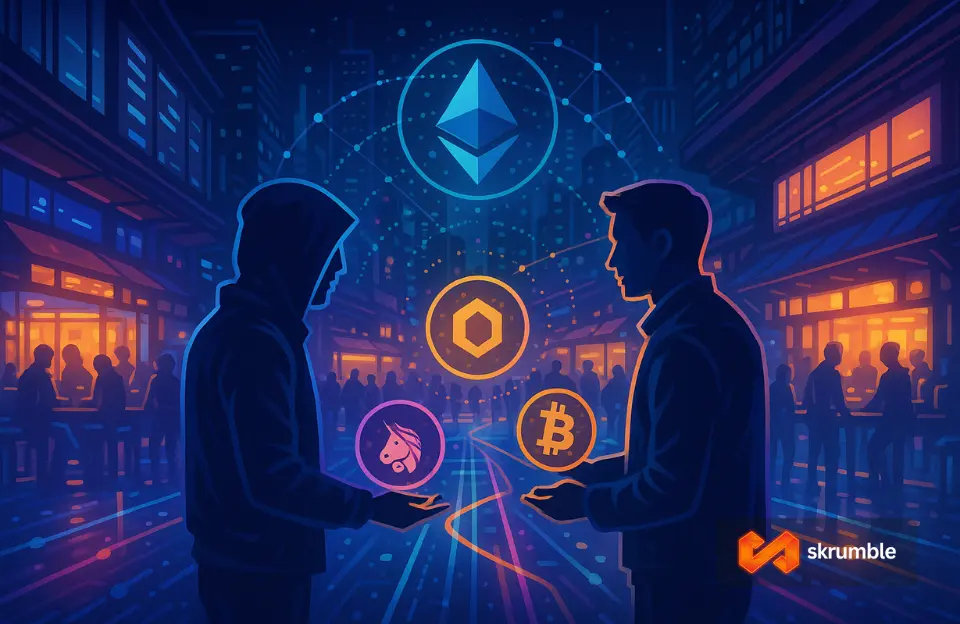
A smart contract is a program deployed on a blockchain that executes automatically when predefined conditions are met. The program code and its execution state live on chain, where they can be read by anyone and cannot be censored or shut down by a single party. The 2026 reality of smart contracts is that they are the foundational unit underlying every other concept on Skrumble: staking, DeFi lending, stablecoins, DEXes, bridges, airdrops, and tokenized real-world assets all run on smart contracts. The Ethereum Virtual Machine (EVM) is the dominant runtime, with Ethereum mainnet plus its L2s (Arbitrum, Base, Optimism, Polygon) plus EVM-compatible L1s (BNB Chain, Avalanche, Cronos) accounting for the majority of deployed contracts. Non-EVM environments include Solana's Sealevel runtime (SVM), Move on Aptos and Sui, and Cairo on StarkNet. The honest 2026 framing: smart contracts have given crypto its distinctive properties (true ownership, programmable money, composability) and have also produced its most expensive failures. DefiLlama's hack database recorded approximately $9.11 billion in cumulative DeFi smart-contract losses through December 2024; the broader REKT database tracks $77.1 billion in DeFi-related scams, hacks, and exploits, with only $6.5 billion recovered. The good news: Q1 2026 smart-contract exploit losses fell 89% year-over-year as auditing practices matured.
This guide on what is a smart contract walks how they work, the EVM as the dominant runtime, the Solana SVM and other non-EVM alternatives, common use cases, Solidity as the dominant smart-contract language, deployment mechanics, the 2026 risk landscape, audit norms, and the cross-chain comparison. For broader blockchain context, see our blockchain pillar guide; for DeFi-specific risk applications, see DeFi lending.
What is a smart contract in 2026?
A smart contract is bytecode stored at a blockchain address. The code defines functions; the chain stores state variables. When a user (or another contract) sends a transaction calling one of those functions, every node on the network executes the code, updates the state, and arrives at the same result. The deterministic execution is what makes the system work without a central operator: every node agrees on the outcome because the program is the law.
The term "smart contract" was coined by Nick Szabo in 1994 to describe digital protocols that could enforce contractual obligations without third-party intermediaries. The first practical implementation at scale arrived with Ethereum in 2015. By 2026 the concept has expanded well beyond Szabo's original scope; modern smart contracts run everything from simple token transfers to billion-dollar lending markets, derivatives protocols, and tokenized money-market funds. The ethereum.org documentation maintains the canonical reference at ethereum.org's smart contract page.
How does a smart contract work?
Three pieces matter mechanically. First, the bytecode: when a developer writes a contract in Solidity, Vyper, or another high-level language, a compiler converts it to EVM bytecode (or SVM bytecode for Solana, MoveVM bytecode for Aptos/Sui, etc.). The bytecode is what actually runs. Second, the contract address: deploying a contract sends a transaction to the chain that creates a new account at a deterministic address derived from the deployer's address and nonce. Other users can then interact with this address. Third, the storage: contract state lives in a key-value store associated with the contract address, persistent across blocks.
A typical interaction looks like this. A user calls the swap() function of a Uniswap V3 pool contract, passing input token, output token, and amount. The node executing the transaction loads the pool's current state (reserves, fee parameters), runs the swap logic, debits the input from the user's balance, credits the output, updates the pool reserves, and writes the new state. Every node arrives at the same updated state because the function is deterministic. The transaction either succeeds or reverts atomically; partial state changes are impossible.
What is the Ethereum Virtual Machine (EVM)?
The EVM is a stack-based virtual machine that executes smart-contract bytecode. It is Turing-complete (any computable function can be expressed in EVM bytecode) but bounded by gas, which prevents infinite loops and resource exhaustion. Every operation has a gas cost; the user pays for the operations their transaction triggers. The gas system gives the network an economic defense against denial-of-service attacks and provides a mechanism for prioritizing transactions during congestion.
The EVM's dominance: Ethereum, plus L2s (Arbitrum, Base, Optimism, Scroll, Linea, zkSync), plus EVM-compatible L1s (BNB Chain, Avalanche, Polygon PoS, Cronos, Fantom, Celo) all run the same EVM bytecode. A contract deployed on Ethereum can be redeployed on any EVM chain with minimal modification. Developer tooling (Foundry, Hardhat, Remix), wallet integration (MetaMask supports any EVM chain via custom RPC), and audit firms all target EVM, producing strong network effects. The 2026 estimate places approximately 95% of all deployed smart-contract value-locked on EVM-compatible chains, with Solana SVM holding the bulk of the non-EVM remainder.
What are smart contracts used for?
Eight categories cover the bulk of 2026 smart-contract activity. Decentralized exchanges (Uniswap, Curve, Balancer, Raydium): smart contracts hold liquidity pools and execute swaps. DeFi lending (Aave, Spark, Compound, Morpho): contracts hold deposits, lend to borrowers, and execute liquidations automatically. Stablecoins (USDC, USDT, DAI, USDS): contracts mint and burn the tokens against fiat-collateral or crypto-collateral reserves. Bridges (Wormhole, LayerZero, Stargate, Across): contracts lock assets on one chain and mint representations on another. Liquid staking (Lido, Rocket Pool, Jito): contracts pool staked assets and issue tradeable liquid-staking tokens.
NFT marketplaces (OpenSea, Blur, Magic Eden): contracts handle listings, bids, escrow, and royalty payments. Governance and DAOs (Compound Governor, Snapshot, Aragon): contracts hold treasury funds, execute proposals, and enforce voting outcomes. Tokenized real-world assets (BlackRock BUIDL, Ondo USDY, Franklin BENJI): contracts represent fractional ownership of off-chain assets like US Treasury Bills. The category boundaries are increasingly fluid: a single user transaction can route through 5-10 contracts across multiple categories (swap on a DEX, deposit into lending, use the deposit token in a vault, etc.).
What is Solidity and how is it used?
Solidity is the dominant high-level smart-contract language for the EVM. It is statically typed, contract-oriented, and syntactically similar to JavaScript and Java. The 2026 mainline release is Solidity 0.8.x, which introduced automatic overflow checks (a major security upgrade that retired one entire vulnerability class). Vyper is the second EVM language, Python-syntax-inspired and security-focused; Vyper has a smaller ecosystem but is used by Curve, Lido, and other security-critical protocols.
A simple smart contract example in Solidity: an ERC-20 token contract is typically 50-200 lines of code defining the token's name, symbol, total supply, balances mapping, and transfer/approve/transferFrom functions. Most production token deployments use the OpenZeppelin ERC-20 implementation as a battle-tested base, then add custom logic on top. Developer tooling: Foundry (Rust-based, fast) and Hardhat (JavaScript-based, mature ecosystem) are the two dominant frameworks in 2026.
How are smart contracts deployed?
Deployment is itself a transaction. The developer compiles the source code to bytecode, signs a deployment transaction that includes the bytecode and constructor parameters, and broadcasts it to the network. The transaction creates a new contract account at a deterministic address; subsequent transactions can call the contract's functions. Deployment costs vary by chain and contract size: a moderately complex DeFi contract costs $50-$500 to deploy on Ethereum mainnet in mid-2026 at typical gas prices; the same deployment on Arbitrum or Base costs $0.50-$5; on Solana, a comparable program deployment costs under $10 in SOL rent.
Once deployed, the contract code is typically immutable. Upgrades require a separate proxy pattern (Transparent, UUPS, Beacon) where the contract address points to a logic address that can be swapped by an admin or governance vote. The 2026 design preference has shifted toward immutable contracts where possible and governance-controlled upgradeable contracts where ongoing change is necessary. Verified source code is published on block explorers (Etherscan, Basescan, Solscan) so users can audit what they are interacting with.
What are the risks of smart contracts?
Five risk classes through 2026. Implementation bugs: incorrect code can be exploited to drain funds. The 2016 DAO hack ($60 million ETH), the 2022 Wormhole bridge hack ($325 million), and the May 2023 Atomic Wallet hack ($100 million) all started with contract-implementation vulnerabilities. Oracle attacks: contracts that depend on price feeds can be manipulated by influencing the feed (October 2022 Mango Markets, October 2024 Polter Finance, multiple smaller incidents). Reentrancy attacks: a contract calling external code before completing its own state updates can be re-entered to drain funds (the DAO hack pattern). Access-control failures: missing or buggy authorization checks let attackers call privileged functions (2024 PlayDapp $290 million mint exploit).
Governance attacks: protocols with on-chain governance can be exploited by acquiring enough governance tokens to pass a malicious proposal (2022 Beanstalk Farms $182 million flash-loan governance attack). The good news on the 2026 trend: implementation bugs have declined from 67% to 40% of attack vectors as auditing and formal verification have matured. Q1 2026 smart-contract exploit losses were down 89% year-over-year. Cumulative DeFi hack losses tracked by DefiLlama's hacks database reached approximately $9.11 billion through December 2024; the broader REKT database tracks $77.1 billion in lifetime DeFi losses with only $6.5 billion recovered. For the user-side risk perspective on lending specifically, see our DeFi lending guide.
How are smart contract audits done?
A smart-contract audit is a security review by specialists looking for bugs, vulnerabilities, and design weaknesses before deployment. The dominant audit firms in 2026 are OpenZeppelin, Trail of Bits, Spearbit, ChainSecurity, Halborn, CertiK, and Quantstamp. A typical audit takes 2-8 weeks and costs $50,000 to $500,000 depending on contract complexity and audit scope. The deliverable is a public report listing findings categorized by severity (Critical, High, Medium, Low, Informational) and recommended fixes.
Audit best practice in 2026 includes: multiple independent audits by different firms (especially for protocols holding over $100 million TVL), formal verification on the most critical contracts (mathematical proof that the code matches the specification), continuous fuzz-testing infrastructure, and bug bounty programs (Immunefi is the dominant platform, with bounties ranging from $10K to $10M depending on protocol value). Audits do not eliminate risk. Multiple audited protocols have been exploited post-audit; auditors review what is present but cannot guarantee that no novel attack vector exists. The 2024-2025 trend toward post-deployment monitoring (Forta, Phalanx, Hypernative) provides defense-in-depth beyond pre-launch audits.
Smart contracts on Ethereum vs Solana vs other chains
The dominant non-EVM environments in 2026 each take a different design approach. Solana's Sealevel runtime (SVM) lets multiple non-conflicting transactions execute in parallel; programs are written in Rust and compiled to SBF bytecode. Solana programs are stateless (state lives in separate accounts that programs read and write), which differs from the EVM's contract-bundled-state design. The parallel execution model is the source of Solana's high throughput.
Move (Aptos and Sui) is a Rust-derived language designed specifically for blockchain state management. Resources (assets) cannot be copied or accidentally destroyed at the language level; the type system enforces correct asset handling. Aptos uses a sequential execution model; Sui uses parallel execution with object-based ownership. Cairo (StarkNet) is a domain-specific language optimized for zero-knowledge proofs; smart contracts on StarkNet are inherently provable to a verifier. The trade-offs across these environments: EVM has the largest developer ecosystem and tooling; Solana has the highest throughput; Move has the strongest type-system safety guarantees; Cairo has native zero-knowledge integration.
Frequently asked questions
Are smart contracts legally binding?
Mixed and jurisdiction-dependent. The code is mechanically self-enforcing; the contract executes regardless of legal status. Whether that on-chain execution corresponds to an enforceable legal contract depends on the underlying parties, terms, and jurisdiction. The 2018 Wyoming DAO LLC law and the 2024 Marshall Islands DAO Act gave some on-chain entities formal legal status. Most consumer smart-contract interactions in 2026 are not treated as legal contracts in the traditional sense; they are protocol actions with whatever legal consequences flow from the underlying activity (e.g., a swap on Uniswap is a sale for tax purposes even though no traditional contract paper exists).
Can a smart contract be hacked?
Yes. Cumulative DeFi smart-contract losses through December 2024 totalled approximately $9.11 billion per DefiLlama. The 2026 trend is sharply improving (Q1 2026 down 89% year-over-year) as auditing, formal verification, and post-deployment monitoring have matured. No smart contract is provably bug-free outside of formally verified implementations; users should evaluate audits, time-in-production, and the size of any insurance backstop before deploying material capital.
Who pays for a smart contract to run?
The user calling the function pays gas fees in the chain's native token (ETH, SOL, MATIC, BNB, etc.). Some protocols sponsor user gas via meta-transactions or account-abstraction (ERC-4337, EIP-7702 on Ethereum) for UX improvement; the sponsor pays in those cases. Gas is paid to network validators or miners as compensation for executing the contract and including it in a block.
Can smart contracts be changed after deployment?
Pure contract bytecode is immutable. Upgradeable contracts use a proxy pattern where a fixed proxy contract delegates calls to a swappable implementation contract. The proxy address is what users interact with; the implementation can change via admin or governance action. Immutable contracts cannot be changed under any circumstances; the trade-off is no recovery from bugs, balanced against guaranteed protocol stability. 2026 design preference: immutability for security-critical primitives (token contracts, AMM pools) and governance-controlled upgrades for evolving protocols (lending, derivatives).
What is the difference between a smart contract and a regular program?
A smart contract runs on a public blockchain in a deterministic environment where every node executes the same code and arrives at the same result. A regular program runs on a single server controlled by a single party. Smart contracts can hold and move cryptocurrency natively; regular programs cannot without integrating with a payment processor. Smart contracts cannot be unilaterally shut down or censored once deployed; regular programs can be shut down at any time by the operator.
Is Solidity the best language for smart contracts?
Dominant in usage but not optimal in safety. Solidity has the largest ecosystem and tooling but its design predated several security best practices and carries technical debt. Vyper offers a smaller but safer alternative for security-critical EVM contracts. Move (Aptos/Sui) offers stronger language-level guarantees about asset handling. Rust on Solana offers performance and safety advantages but a steeper learning curve. For new EVM projects in 2026, Solidity remains the practical default; for new non-EVM projects, Move and Rust are strong language choices.
How can I tell if a smart contract is safe to interact with?
Five practical checks. First, verify the contract source code on the block explorer (Etherscan, Basescan, Solscan): if the source is unverified, treat as high-risk. Second, check published audit reports: look for recent audits from reputable firms (OpenZeppelin, Trail of Bits, Spearbit). Third, examine the time the contract has been in production handling real value: contracts with 2+ years of mainnet operation under material TVL carry lower marginal risk than new launches. Fourth, check for known incidents at DefiLlama's hack database or REKT News. Fifth, simulate the transaction (use a transaction simulator like Tenderly or wallet Snaps like Wallet Guard) before signing to see what the call actually does.
Are smart contracts taxable?
The contract itself is not a taxable event. Interactions with smart contracts can produce taxable events: a swap on a DEX is a sale for tax purposes; lending to a DeFi protocol that pays interest produces ordinary income; staking through a smart contract produces ordinary income at receipt. The taxable framework follows the economic substance of the interaction, not the form of the contract call. For the broader US treatment, see our crypto tax USA 2026 guide.
Frequently asked questions
Are smart contracts legally binding?
Can a smart contract be hacked?
Who pays for a smart contract to run?
Can smart contracts be changed after deployment?
What is the difference between a smart contract and a regular program?
Is Solidity the best language for smart contracts?
How can I tell if a smart contract is safe to interact with?
Are smart contracts taxable?
Sources
- [1]Ethereum.org: Smart contract documentation · Ethereum Foundation · accessed
- [2]Solidity Language: Official documentation · Solidity · accessed
- [3]OpenZeppelin: Smart contract audit reports and Contracts library · OpenZeppelin · accessed
- [4]DefiLlama: DeFi hacks and exploits database · DefiLlama · accessed
- [5]Foundry Book: Smart contract development framework · Foundry · accessed
More in Blockchain fundamentals
What is Blockchain? 2026 Complete Guide
What is blockchain? A 2026 guide to Layer 1 + Layer 2 architecture, PoW vs PoS consensus, real-world use cases beyond crypto, and the honest limitations.
What is a Rollup? 2026 Optimistic + ZK L2 Guide + TVL
What is a rollup in 2026: 73 active Ethereum L2s with $48B TVL, optimistic vs ZK trade-offs, Arbitrum + Base lead at 77% combined share, post-EIP-4844 fees.
What is Tokenization? 2026 RWA + Tokenized Assets Guide
What is tokenization in 2026: $29B RWA market across Treasuries, private credit, equities, real estate; BlackRock, Apollo, Hamilton Lane lead institutional issuance.
What is a Zero Knowledge Proof? 2026 zk-SNARK + STARK Guide
What is a zero knowledge proof in 2026: cryptographic prove-without-revealing primitive, zk-SNARK vs zk-STARK trade-offs, ZK rollup scaling, ZK identity systems.
What is Bitcoin Mining? 2026 Post-Halving Guide
What is Bitcoin mining? 2026 post-halving: 3.125 BTC block reward, 800+ EH/s hashrate, sub-20 J/TH ASICs, retail-unprofitable + industrial-only economics.